 Art
Art
Postmodern art describes the pluralistic period from roughly 1970 to 2000, when artists across Europe and the Americas abandoned modern art's belief in steady formal progress toward a single correct style. Where modernism had prized originality, purity of medium, and a clear line of movements each superseding the last, postmodern artists instead quoted, mixed, and questioned — borrowing freely from art history, advertising, and popular culture, often with open irony. Conceptual art had already begun asking whether an idea alone could constitute the artwork, and postmodernism inherited that skepticism about objects, extending it into appropriated imagery, staged photography, and text-based work that treated meaning itself as unstable and constructed. Painting, declared exhausted by some critics, returned anyway through Neo-Expressionist canvases and pattern-heavy decorative work, while graffiti moved from subway cars into galleries and a new generation of British artists courted shock and tabloid headlines. Across all of it ran a suspicion of grand explanations — of progress, of a single art history, of any style claiming to be the inevitable next step — replaced by deliberate mixture, quotation, and critique.
The look: what defines Postmodern Art
Appropriation and quotation
Postmodern artists freely borrowed and re-photographed existing images — advertisements, art-historical masterworks, film stills — treating originality itself as a modernist myth worth questioning rather than a virtue to preserve.
Irony and pastiche
Work often mixes styles and historical references with deliberate irony, refusing a single sincere voice and instead layering quotation, humor, and critique so meaning always stays deliberately unstable or multiple.
Return of figuration
After decades of abstraction's dominance, raw, expressive figurative painting returned loudly through Neo-Expressionism, favoring large scale, rough handling, and emotionally charged, sometimes crude imagery over refined technique or careful academic finish.
Text and idea over object
Conceptual approaches treated language, instructions, and documentation as legitimate artworks in themselves, sometimes dispensing with a crafted physical object entirely in favor of an idea, a photograph, or a statement.
Street and subcultural imagery
Graffiti's spray-painted lettering and characters moved from subway trains and city walls into galleries, bringing hip-hop and street subculture's visual energy into a fine-art context previously closed off to it entirely.
Provocation and mass media
Artists increasingly used shock, taboo subject matter, and tabloid-ready spectacle to provoke reaction, treating media coverage and public controversy itself as part of the artwork's meaning, reach, and wider circulation.
The story
By the early 1970s, modern art's confident march through successive styles had stalled. Conceptual art, which had emerged in the late 1960s insisting an idea could be the artwork itself, pushed galleries toward text, documentation, and instructions rather than crafted objects, and its skepticism about originality and the art object carried directly into what critics began calling postmodernism.
Painting, widely declared finished, returned anyway in the early 1980s through Neo-Expressionism, a loud, raw, figurative style that emerged in Germany, Italy, and the United States, reclaiming scale and emotional directness after a decade of conceptual restraint. Around the same time, Pattern and Decoration artists reclaimed textile, craft, and ornamental sources long dismissed as merely decorative, while Neo-Geo artists in New York recycled hard-edged abstraction with a cool, commercial irony aimed squarely at consumer culture.
Graffiti art, which took hold on New York's streets and subway cars around 1970, crossed into downtown galleries by the early 1980s, bringing street lettering and character work into fine-art contexts. By the 1990s, a group of Young British Artists, backed by ambitious collectors and heavy media coverage, made shock, spectacle, and conceptual bravado central to British contemporary art, closing the century with a deliberately provocative, media-savvy sensibility that carried postmodern irony into the era of global contemporary art.
Timeline
- 1970Conceptual art's object-skeptical approach gains wide gallery traction
- 1973c. graffiti writing culture flourishes on New York subway cars
- 1975c. Pattern and Decoration movement coalesces among New York artists
- 1980Neo-Expressionist painting returns figuration to major galleries
- 1986Neo-Geo artists debut in New York galleries
- 1988Young British Artists group emerges from a London student show
- 1997Sensation exhibition brings Young British Artists wide attention
- 2000Postmodern era gives way to a more global contemporary art world
Works to know
| Work | Maker | Date | Why it matters |
|---|---|---|---|
| Untitled Film Stills | Cindy Sherman | 1977–1980 | Series of staged photographs of the artist in invented roles, mimicking movie stills, a touchstone for postmodern photography's questioning of image and identity. |
| The Physical Impossibility of Death in the Mind of Someone Living | Damien Hirst | 1991 | A shark preserved in formaldehyde, the signature work of the Young British Artists' shock-driven conceptualism. |
| Crack Is Wack | Keith Haring | 1986 | Public mural bringing graffiti-derived line and social message into a highly visible New York City site. |
| Balloon Dog | Jeff Koons | 1994–2000 | Oversized stainless-steel sculpture mimicking a balloon animal, embodying postmodern art's cool embrace of consumer and kitsch imagery. |
| My Bed | Tracey Emin | 1998 | Installation of the artist's own unmade bed, a landmark of Young British Artists' confessional conceptualism. |
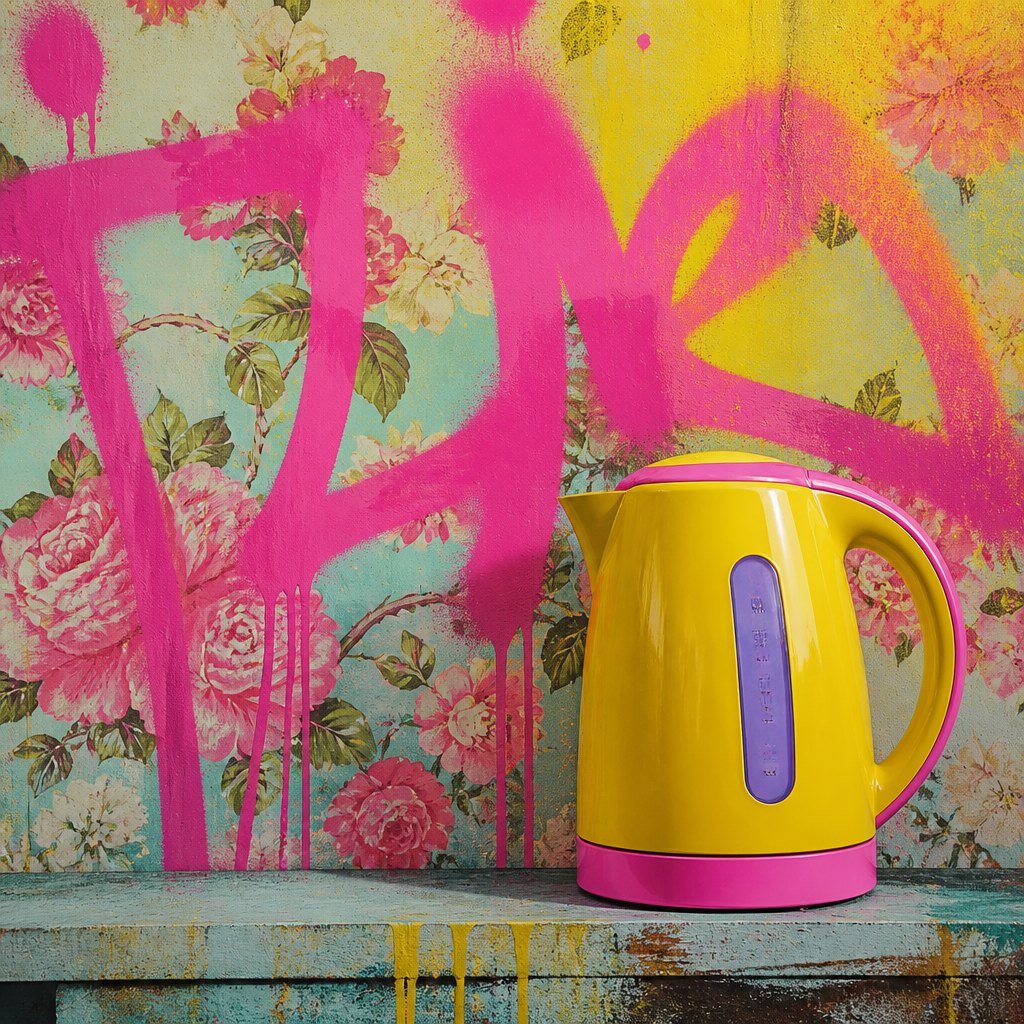 AI-generated
Make it yourself
Create art in the Postmodern Art spirit
This interpretation was generated from a prompt like: “A mixed-media composition layering bold spray-paint lettering over a faded decorative floral pattern, an ordinary household object rendered in glossy consumer-product color, deliberately clashing styles, flat irony, urban wall texture, bright unblended color.”
Open the Postmodernism Art Style generator →How to evoke the period
Combine sources that do not obviously belong together — a historical composition style paired with a contemporary consumer object, or a decorative pattern layered under a raw, expressive figure — and let the mismatch itself carry meaning. Favor bold, unblended color and confident, sometimes deliberately crude mark-making over refined finish. If working with text, treat words or instructions as part of the image rather than a caption beneath it. Borrow lettering energy from street and spray-paint aesthetics: bold outlines, drips, and layered tags. Keep the overall tone knowing and a little ironic rather than earnest, and do not worry about resolving the mixture into one consistent style — inconsistency is the point.
What it left behind
Postmodernism's core moves — appropriation, irony, mixing high and low sources, treating an idea or gesture as sufficient artwork — remain standard tools for artists working today, so thoroughly absorbed that they rarely register as radical anymore. Its skepticism about a single correct style opened the door to the genuinely global, multi-directional contemporary art world that followed, where no single capital or movement sets the agenda. The era's comfort with shock, media spectacle, and confessional autobiography also reshaped how contemporary artists build public reputations, treating controversy and visibility as part of an artwork's life rather than a distraction from it.
Frequently asked questions
What is postmodern art?
Postmodern art is the pluralistic period roughly from 1970 to 2000 when artists rejected modern art's belief in one correct stylistic progress, instead mixing styles, quoting existing imagery, and treating irony and appropriation as legitimate artistic tools.
How is postmodern art different from modern art?
Modern art pursued a sequence of movements each claiming to advance art toward a purer style; postmodern art rejected that single narrative, freely mixing historical references, media, and tones instead of pursuing one correct direction.
What are the Young British Artists?
A loose group of artists who emerged from London art schools in the late 1980s and gained fame through shock-driven, media-savvy conceptual works, backed by prominent collectors and heavy press coverage through the 1990s.
Is graffiti art part of postmodern art?
Yes — graffiti's spray-painted lettering and characters moved from New York subway cars into downtown galleries in the 1980s, bringing street subculture's visual energy into the postmodern fine-art conversation.