 Art
Art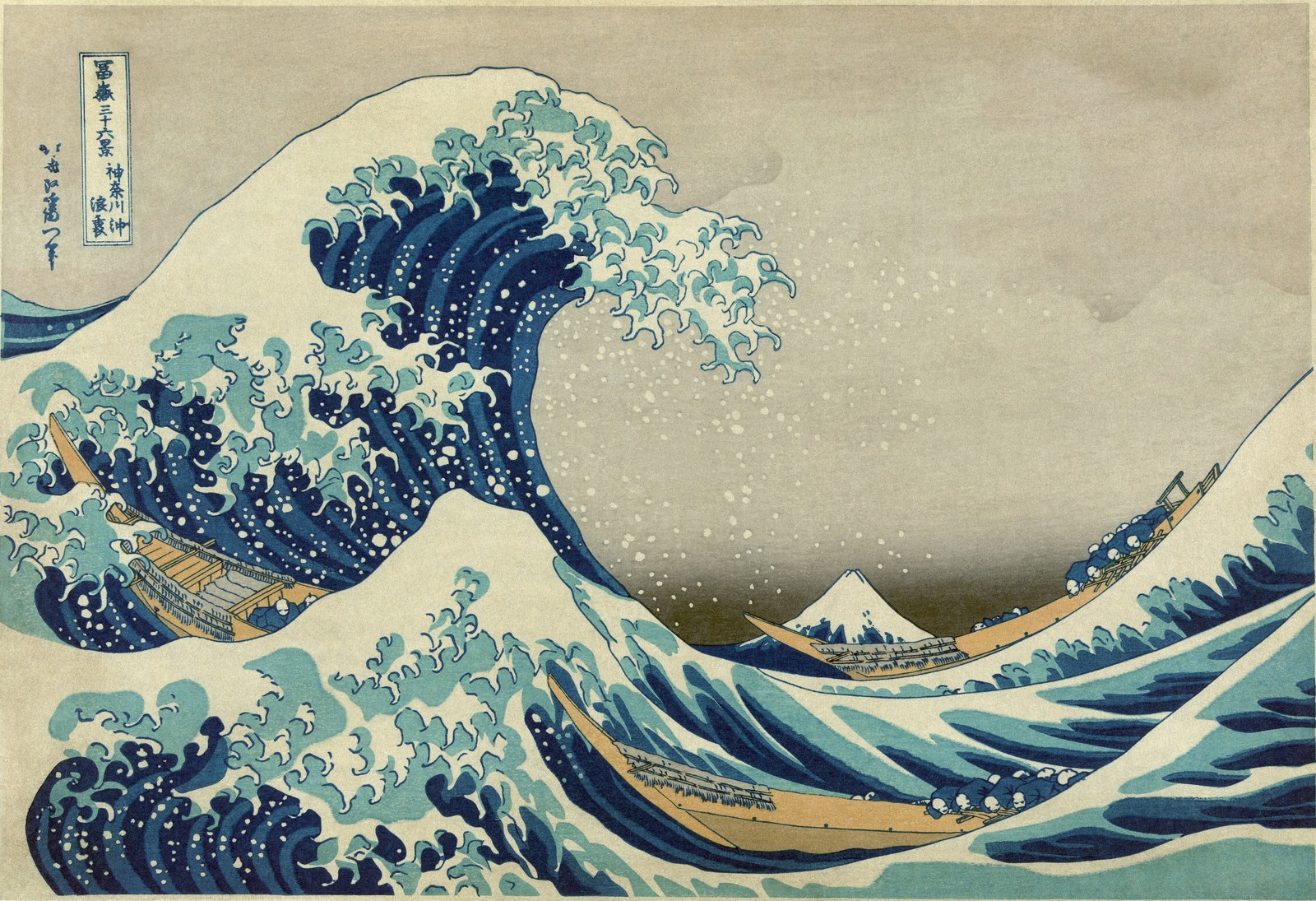
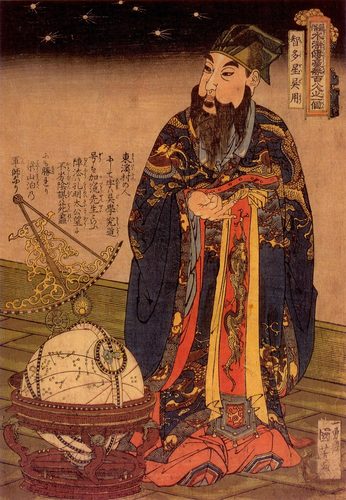
Edo period art spans 1603 to 1868, the roughly 250 years Japan was governed by the Tokugawa shogunate from its capital at Edo (now Tokyo), a stretch of enforced peace and near-total isolation from the outside world. With the samurai class pacified into administrators and a merchant class growing wealthy on rice, sake, and textiles, patronage shifted from temples and warlords toward a broad urban public hungry for entertainment and status objects. Painting continued in aristocratic and Zen traditions, but the era's defining innovation was the woodblock print, cheap enough to sell by the thousand and fast enough to track the latest kabuki star or courtesan-district gossip. Publishers, carvers, and printers turned Edo and Osaka into image factories, while lacquerware, ceramics, and richly dyed kimono textiles supplied a taste for pattern and surface. Confucian order shaped official life, but the licensed pleasure quarters and theater districts produced a parallel culture the shogunate tolerated, taxed, and occasionally censored. By the time foreign ships forced Japan's ports open in the 1850s, this closed, self-referential visual world was primed to spill outward — and would reshape painting in Paris within a generation.
The look: what defines Edo Period Art
Flat color woodblock prints
Ukiyo-e prints built images from flat planes of vivid color separated by clean outlines, achieved by carving a separate block for each hue and pressing them in careful registration. The technique favored bold pattern over shading, giving prints of actors, beauties, and landscapes a poster-like graphic punch.
Floating world subjects
Kabuki actors mid-pose, courtesans in elaborate dress, sumo wrestlers, and travelers on famous roads were the era's core subjects — the fleeting, fashionable 'floating world' of pleasure districts and popular entertainment rather than court or religious scenes.
Gold-ground folding screens
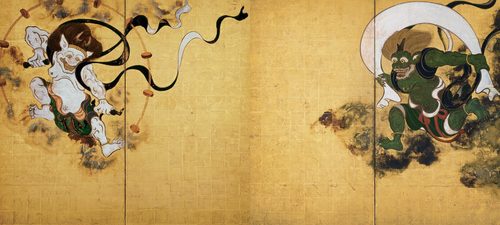
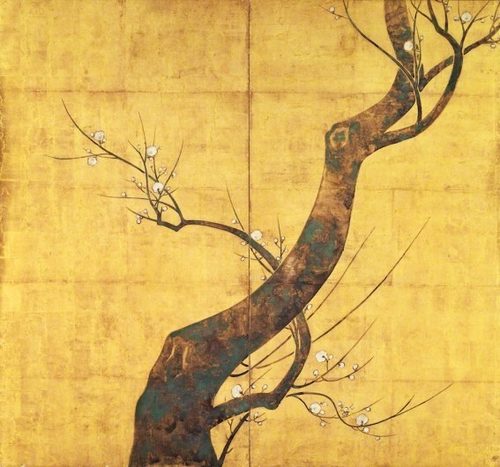
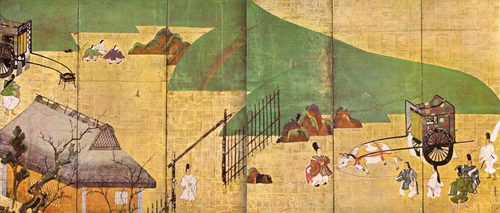
Elite painting schools produced large folding screens and sliding doors coated in gold leaf, with pine trees, cranes, or seasonal flowers rendered in flattened, decorative space meant to catch candlelight in a dim room and expand it.
Bold asymmetrical composition
Compositions favored dramatic cropping, steep diagonals, and empty space over centered symmetry — a distant Mount Fuji glimpsed through a wave's curl, or a figure sliced by the frame's edge, conventions later prized by European painters.
Lacquer and layered pattern
Lacquerware boxes and furniture built up dozens of thin coats over wood, inlaid with gold dust or mother-of-pearl, while textiles layered dyed and embroidered pattern on pattern, reflecting a culture that prized surface refinement and craft precision.
Everyday life as subject
Street vendors, teahouses, weather, and seasonal festivals appeared alongside celebrities, treating ordinary urban life as worthy subject matter — a shift toward the commercial, comic, and momentary that set the era apart from earlier court art.
The story
When Tokugawa Ieyasu unified Japan and established his government at Edo in 1603, he inaugurated over two centuries of internal peace enforced by strict social hierarchy and, from the 1630s, near-total closure to foreign trade and travel. Samurai were converted from soldiers into salaried bureaucrats, while merchants — officially the lowest social class — quietly became the wealthiest, and their money reshaped what art was made and for whom.
Painting at court and in Zen temples carried on established traditions of ink landscape and gold-screen decoration, but the era's real engine was the commercial print industry that grew up in Edo, Osaka, and Kyoto. Publishers commissioned ukiyo-e — 'pictures of the floating world' — depicting kabuki actors, courtesans, sumo champions, and later, landscapes and travel scenes tied to popular pilgrimage routes and the road to Mount Fuji. These prints were mass-produced, inexpensive, and disposable, closer to posters than to fine art, letting them track fashion and celebrity in near real time.
The shogunate periodically cracked down on the pleasure quarters and their imagery through sumptuary laws, but demand only pushed print technique further, adding delicate color gradation and finer line work by the early 1800s. When foreign gunboats forced open Japanese ports in 1853–54, the flood of prints and objects that reached Europe helped ignite the vogue for Japonisme among French painters within a decade.
Timeline
- 1603Tokugawa Ieyasu founds the shogunate, capital moves to Edo
- 1635Sakoku edicts sharply restrict foreign trade and travel
- 1657Great Meireki fire devastates Edo, spurring rebuilding
- 1765Full-color nishiki-e woodblock printing technique emerges
- 1830c. 1830 Hokusai's Thirty-Six Views of Mount Fuji series appears
- 1853Foreign warships arrive, forcing open Japanese ports
- 1868Meiji Restoration ends the shogunate and the Edo period
Works to know
| Work | Maker | Date | Why it matters |
|---|---|---|---|
| Thirty-six Views of Mount Fuji (including The Great Wave off Kanagawa) | Katsushika Hokusai | c. 1830–1832 | A woodblock print series that made Mount Fuji a visual icon and became one of the most reproduced images in art history. |
| The Fifty-three Stations of the Tokaido | Utagawa Hiroshige | 1833–1834 | A print series following Japan's great coastal highway, prized for its atmospheric weather and seasonal light. |
| Red and White Plum Blossoms | Ogata Korin | c. 1710s | A gold-ground folding screen pairing a stylized stream with flowering plum trees, a landmark of the decorative Rinpa school. |
| Wind God and Thunder God | Tawaraya Sotatsu | c. 1621–1639 | A pair of two-panel screens of Japanese wind and thunder deities in bold gold and pattern, repeatedly copied by later Rinpa artists. |
| Beauty Looking Back | Hishikawa Moronobu | c. 1690 | An early ukiyo-e painting of a fashionably dressed woman glancing over her shoulder, a touchstone image for the floating-world genre. |
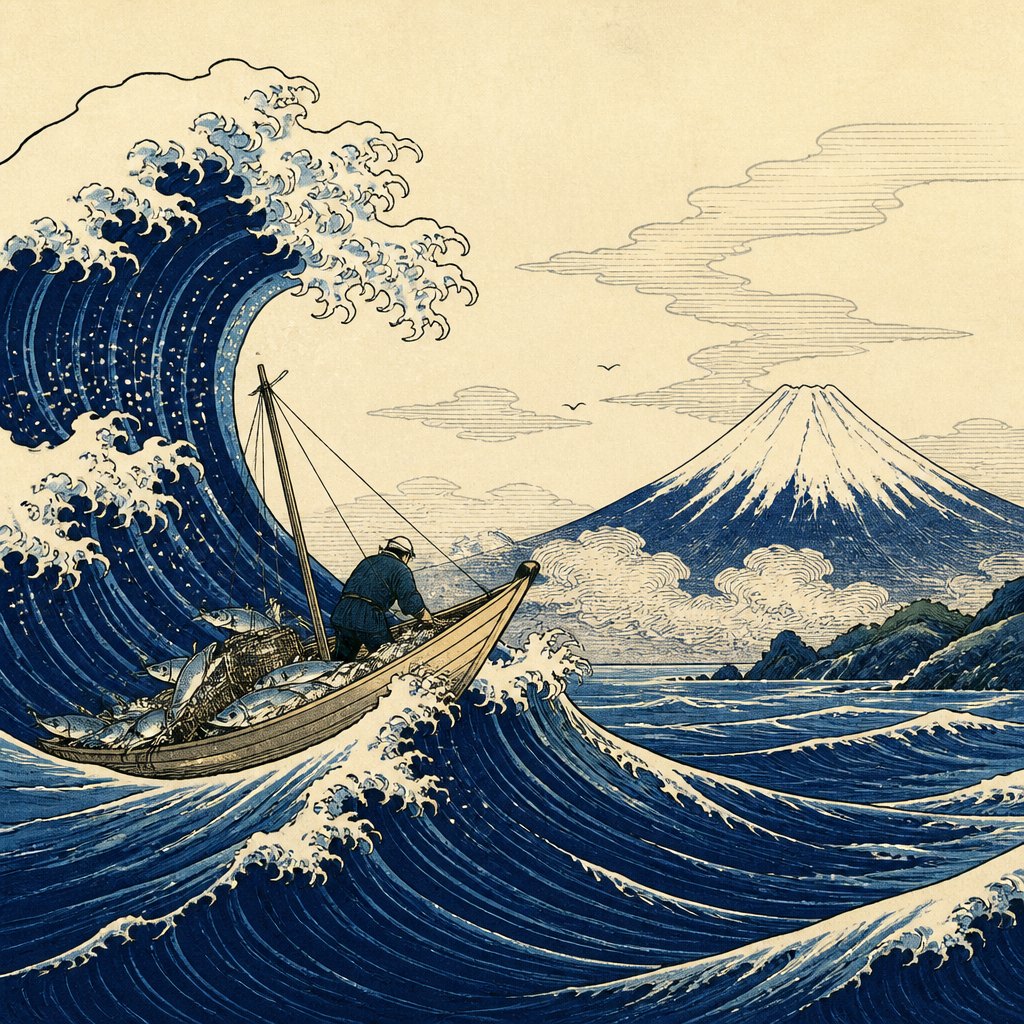 AI-generated
Make it yourself
Create art in the Edo Period Art spirit
This interpretation was generated from a prompt like: “A woodblock-print-style scene of a fishing boat cresting a curling indigo wave beneath a distant snow-capped mountain, flat saturated color, crisp black outlines, pale cream sky, asymmetrical composition, fine linear texture in the water and clouds.”
Open the Edo Period Art Style generator →How to evoke the period
Build the image from flat, saturated color fields with crisp, confident outlines rather than blended shading — think color-separated printing, not painting. Favor asymmetrical composition: push the horizon high or low, let a wave, branch, or roofline slice dramatically across the frame, and leave generous empty space to breathe. Draw subjects from urban and travel life — a covered market stall, a traveler on a mountain road, a heron on a reed bank — rendered with clean, calligraphic line work. Keep the palette to indigo blue, soft coral, warm ochre, and ink black against pale cream paper. Add fine, repeating pattern to clothing or borders, and let clouds or mist appear as flat stylized bands rather than realistic gradients.
What it left behind
Edo-period prints reached Europe in the 1850s and 1860s as packing paper and curiosities, and painters from Monet to Van Gogh collected them, borrowed their flattened space, cropped compositions, and everyday subjects, helping spark the vogue called Japonisme. The woodblock print's mass-production model — cheap, fast, tied to celebrity and fashion — anticipated the logic of modern poster art and illustration. The Rinpa school's decorative gold-ground painting influenced twentieth-century Japanese design, while the era's meticulous lacquer and textile crafts remain benchmarks for material refinement. Contemporary manga and graphic design still lean on ukiyo-e's flat color, bold outline, and asymmetrical framing.
Frequently asked questions
What is Edo period art?
Edo period art refers to the painting, prints, and crafts made in Japan between 1603 and 1868, under the Tokugawa shogunate. It spans elite gold-screen painting, lacquerware, and above all the mass-produced woodblock prints known as ukiyo-e.
When was the Edo period?
The Edo period ran from 1603, when Tokugawa Ieyasu founded his shogunate at Edo (now Tokyo), to 1868, when the Meiji Restoration ended samurai rule and opened Japan fully to the outside world.
What is ukiyo-e?
Ukiyo-e, meaning 'pictures of the floating world,' was a genre of Japanese woodblock prints and paintings depicting kabuki actors, courtesans, sumo wrestlers, and later landscapes, produced cheaply and sold widely to an urban public.
Why is The Great Wave so famous?
The Great Wave off Kanagawa combines a dramatic composition, bold flat color, and an accessible, mass-produced format, making it one of the most widely reproduced and recognized images in the history of art.