 Art
Art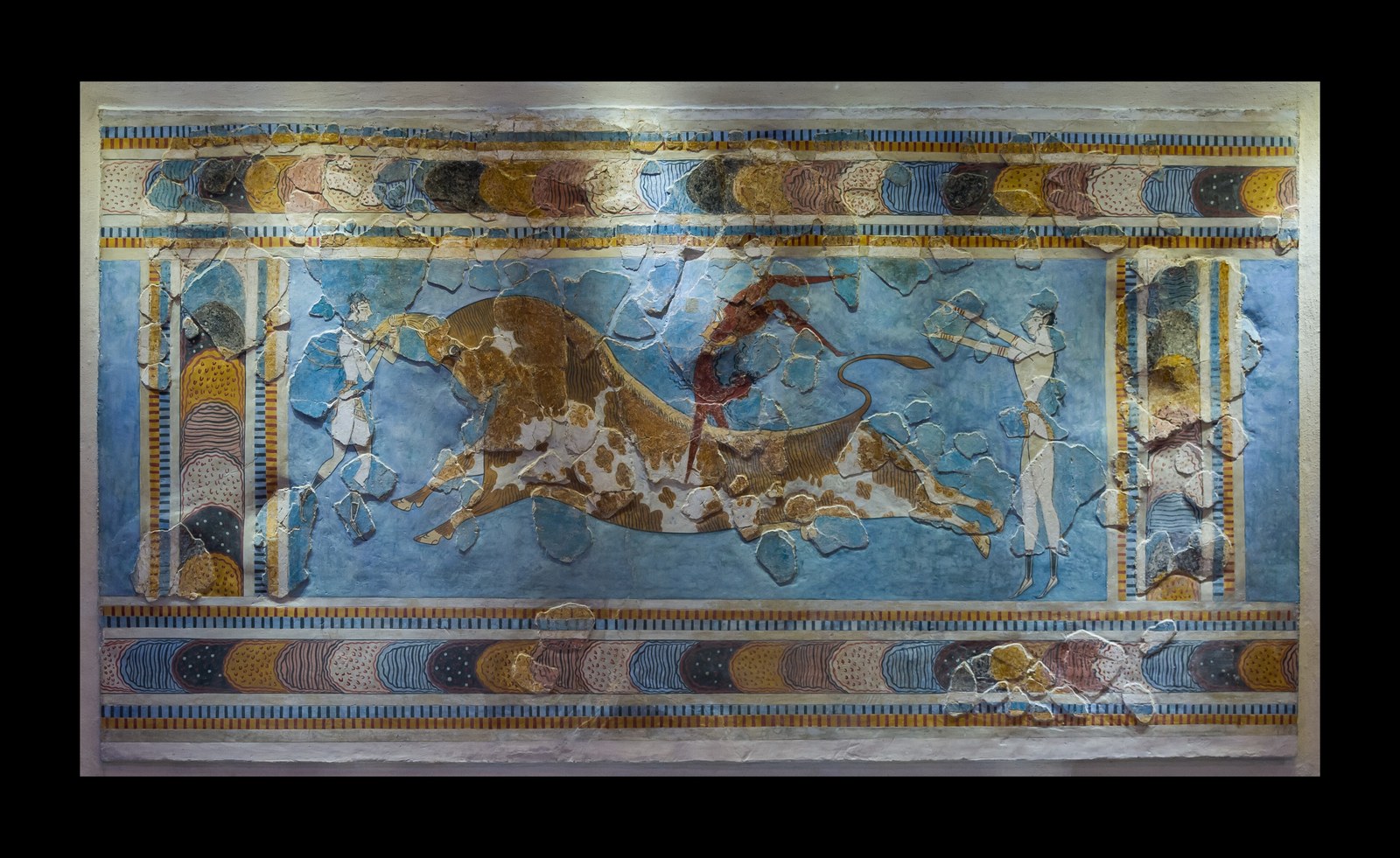
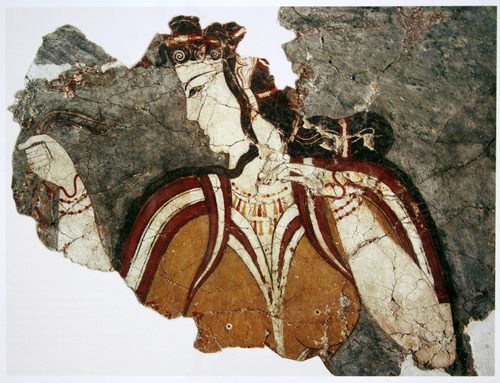
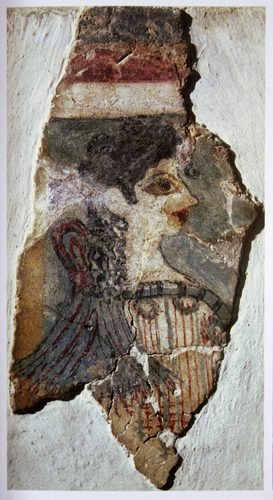
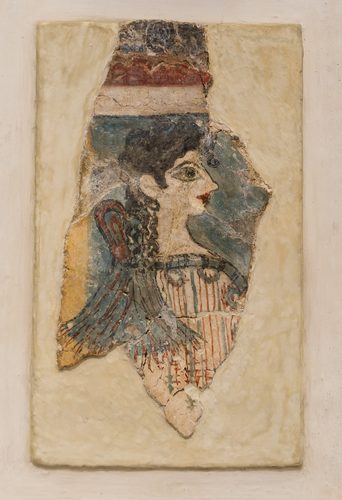
Aegean art is the Bronze Age art of the islands and coasts around the Aegean Sea — Crete, the Cycladic islands, and mainland Greece — made roughly between 3000 and 1100 BCE, before the emergence of the city-states of Classical Greece. It groups three related but distinct traditions: the spare marble figurines of the early Cycladic islands, the fresco-covered palaces of Minoan Crete, and the fortified citadels and gold-rich tombs of Mycenaean Greece. These were maritime, trading societies, and their art reflects it — sea creatures, ships, and imported materials recur throughout, alongside a confident, unfussy sense of pattern and motion rare elsewhere in the ancient world at this date. Minoan Crete in particular produced art strikingly different from its Egyptian and Near Eastern contemporaries: airy, brightly colored frescoes of dolphins, dancers, and bull-leapers, made for palace complexes that combined religious, economic, and residential functions without the heavy defenses seen elsewhere. Mycenaean art, which followed and eventually absorbed Minoan influence, is harder-edged and more warlike, built around royal tombs stocked with gold. Much of what we know comes from archaeology rather than surviving texts, since Aegean scripts remain only partly deciphered.
The look: what defines Aegean Art
Cycladic marble figurines
Early Cycladic sculptors carved slender, flat-faced marble figures, arms folded across the chest, in a spare, abstracted style that strips the body down to essential lines and planes, mostly found in graves.
Marine and nature motifs
Minoan art is filled with the sea — octopuses, dolphins, flying fish, and swaying seaweed — painted with fluid, curving lines across pottery and palace walls, alongside lilies, birds, and other naturalistic plant life.
Vivid fresco painting
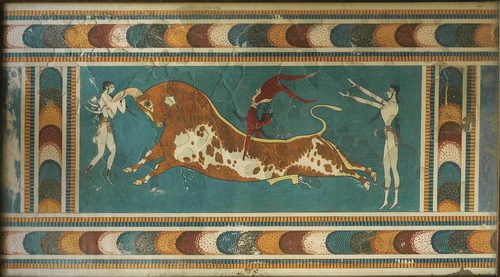
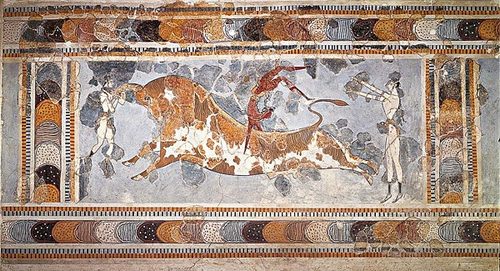
Minoan palaces were decorated with true fresco, pigment applied to wet plaster, depicting processions, dancers, and athletic bull-leaping scenes in bright color and confident, energetic movement rare in the ancient Mediterranean.
Open, unfortified palace complexes
Minoan centers like Knossos were sprawling, multi-story complexes with light wells, storage magazines, and painted courts, built without the massive defensive walls common elsewhere, suggesting relative security through sea power and trade.
Mycenaean gold funerary goods
Mycenaean shaft graves held gold masks, cups, and jewelry of striking craftsmanship, buried with rulers to display and carry wealth into death, a far more martial and status-driven use of precious metal than Minoan art.
Cyclopean fortress architecture
Mycenaean citadels such as Mycenae and Tiryns were enclosed by massive walls of huge, roughly fitted stone blocks, later called "Cyclopean" for their scale, guarded by monumental gateways carved with heraldic beasts.
The story
Aegean art opens with the Cycladic culture of the early Bronze Age, whose scattered island communities produced the spare, geometric marble figurines that would later fascinate modern sculptors. Around 2000 BCE, Crete's first palaces rose at Knossos, Phaistos, and elsewhere, marking the start of Minoan civilization — a prosperous, trade-connected society whose art favored open, unfortified palace complexes decorated with vivid frescoes of nature, ritual, and sport rather than warfare.
Minoan art reached its height in the centuries after 1700 BCE, following the rebuilding of palaces destroyed by earthquake, with bull-leaping frescoes, marine-motif pottery, and finely carved stone vessels produced for a confident maritime culture with trading links across the eastern Mediterranean.
Mycenaean Greece, on the mainland, developed alongside and then eclipsed Minoan Crete: after a volcanic eruption on Thera and Crete's decline, Mycenaean warrior-kings took control of Knossos itself. Mycenaean art absorbed Minoan techniques but turned them toward a harder, more hierarchical culture centered on fortified citadels and richly furnished royal tombs, their gold masks and inlaid weapons announcing status rather than nature's abundance.
Around 1200 BCE, Mycenaean palace centers collapsed amid wider Eastern Mediterranean upheaval, and by 1100 BCE the palace-based Aegean Bronze Age had given way to a poorer, less centralized era that later Greek tradition remembered only dimly, as legend.
Timeline
- 3,000 BCEc. Early Cycladic marble figurines carved across the island chain
- 1,900 BCEc. First Minoan palaces built at Knossos and Phaistos
- 1,700 BCEc. Minoan palaces rebuilt and frescoed after earthquake damage
- 1,600 BCEc. Mycenaean shaft graves furnished with gold funerary masks
- 1,500 BCEc. Eruption of Thera precedes Minoan Crete's decline
- 1,400 BCEc. Mycenaeans take control of Knossos
- 1,250 BCEc. Cyclopean walls and Lion Gate built at Mycenae
- 1,100 BCEAegean Bronze Age ends after the Mycenaean palace collapse
Works to know
| Work | Maker | Date | Why it matters |
|---|---|---|---|
| Cycladic Figurines (folded-arm type) | Unknown | c. 2700–2300 BCE | Slender, abstracted marble figures from the Cyclades, their pared-down forms later admired by modern sculptors for their striking simplicity. |
| Bull-Leaping Fresco, Knossos | Unknown | c. 1450 BCE | Painted plaster fresco from the palace at Knossos showing acrobats vaulting over a charging bull, a signature image of Minoan athletic ritual. |
| Octopus Vase (Marine Style pottery) | Unknown | c. 1500 BCE | Minoan pottery decorated with a sprawling octopus whose curling tentacles wrap the vessel's curved surface, exemplifying Marine Style ceramic design. |
| Mask of Agamemnon | Unknown | c. 1550–1500 BCE | Gold funerary mask from a Mycenaean shaft grave, named after the legendary king though centuries too early to depict him. |
| Lion Gate, Mycenae | Unknown | c. 1250 BCE | Monumental stone gateway topped with a relief of two heraldic lionesses, the grand ceremonial entrance to the citadel of Mycenae. |
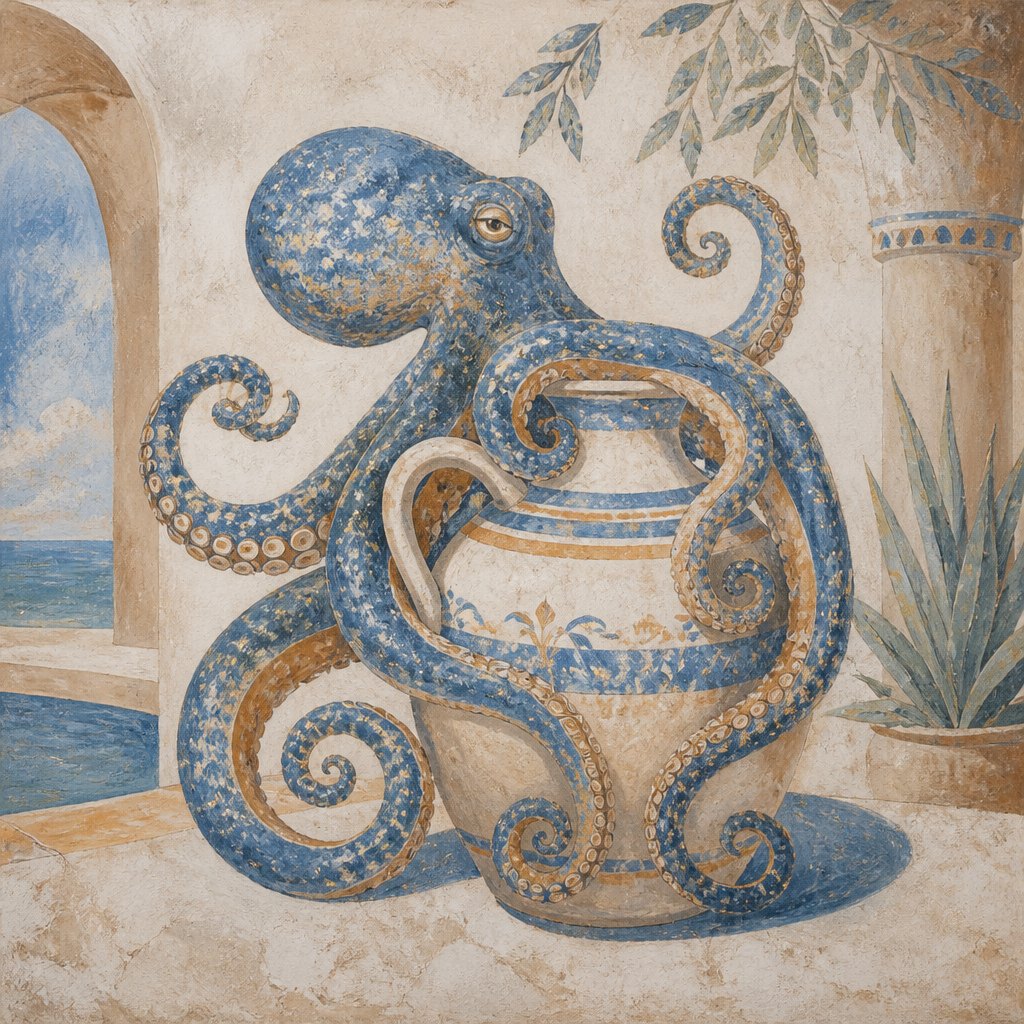 AI-generated
Make it yourself
Create art in the Aegean Art spirit
This interpretation was generated from a prompt like: “A fresco-style painting of an octopus with curling tentacles wrapped around a curved ceramic vessel, fluid painted lines, fresh sea-blue and ochre pigment on plaster-white ground, light Mediterranean palace courtyard setting.”
Open the Minoan Fresco Art Style generator →How to evoke the period
For Minoan-style imagery, favor fluid, curving lines and marine life — octopuses, dolphins, spiraling waves — painted in fresh blues, ochre, and terracotta on a light plaster-white ground, with energetic, unposed movement rather than stiffness. For Cycladic-style work, strip figures down to flat, simplified planes in pale, unpolished marble tones, arms folded, features minimal. For Mycenaean-style imagery, shift toward gold and bronze against dark stone, heraldic animal pairs flanking a central form, and massive, roughly fitted stone architecture. Across all three, keep compositions open and airy for Minoan subjects, heavier and more fortified for Mycenaean ones, and let pattern carry as much weight as the subject itself.
What it left behind
Aegean art gave later Greek civilization a set of foundational myths — Minos, the Minotaur, Agamemnon's Mycenae — built from real palaces and tombs that later Greeks could still see in ruin, half-remembered as a heroic age. Its confident, naturalistic painting style, showing motion and nature without the rigid conventions of Egypt or the Near East, anticipated qualities Classical Greek art would later prize. Cycladic figurines, rediscovered and exhibited only in the twentieth century, influenced modern sculptors drawn to their spare abstraction. Mycenaean gold work and fortress architecture shaped how later Greeks imagined their own heroic past, feeding directly into Homeric epic and, through it, the Western literary imagination.
Frequently asked questions
What is Aegean art?
Aegean art is the Bronze Age art of Crete, the Cycladic islands, and mainland Greece, made roughly between 3000 and 1100 BCE, including Cycladic marble figurines, Minoan palace frescoes, and Mycenaean gold funerary goods.
What is the difference between Minoan and Mycenaean art?
Minoan art, from Crete, is open, naturalistic, and marine-themed, made for unfortified palaces. Mycenaean art, from mainland Greece, is harder-edged and status-driven, centered on fortified citadels and gold-rich royal burials.
Why are Cycladic figurines so simplified?
Early Cycladic sculptors worked marble into flat, abstracted human forms, likely for funerary or ritual use; the pared-down style may reflect available tools and materials as much as deliberate artistic choice.
What happened to Aegean civilization?
Minoan Crete declined after a volcanic eruption on Thera and later Mycenaean takeover; Mycenaean palace centers then collapsed around 1200 BCE amid wider regional upheaval, ending the Aegean Bronze Age by about 1100 BCE.