 Art
Art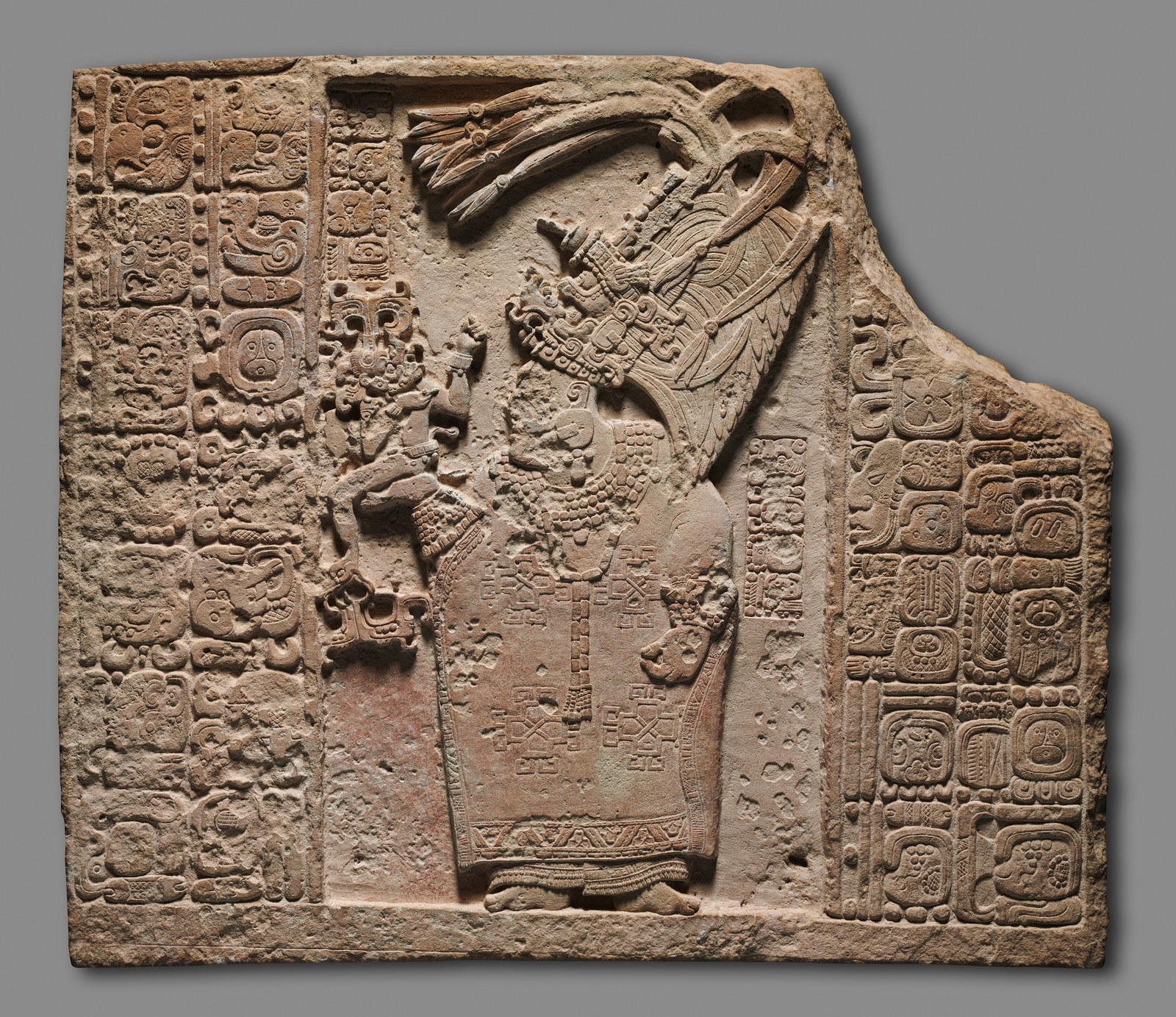
Pre-Columbian art covers the visual traditions of the Americas from roughly 1500 BCE, when settled societies in Mesoamerica began building monumental architecture, to 1532 CE, when the Spanish conquest of the Inca Empire closed the era of independent Indigenous rule. It is not one culture but hundreds, spanning millennia and a hemisphere — the Olmec of the Gulf Coast, the Maya city-states of the Yucatan and Guatemala, the Aztec (Mexica) empire centered at Tenochtitlan, and the Inca empire that stretched along the Andes. Despite this diversity, common threads recur: art served religion, kingship, and the tracking of astronomical and agricultural cycles rather than private ownership or individual expression as later understood in Europe. Temples and pyramids were built to align with solstices and to house rulers understood as intermediaries with the divine. Stone carving, mural painting, ceramics, textiles, feather work, and metalwork in gold, silver, and copper reached extraordinary technical sophistication, often without wheeled tools or draft animals. These societies also kept detailed records — Maya hieroglyphic script and Andean khipu cords — making the period's art part of a broader documentary culture in its own right.
The look: what defines Pre-Columbian Art
Stepped pyramid temples
Monumental stone pyramids with stepped terraces and steep stairways served as temples and tombs, often aligned to solstices or planetary cycles — the Maya, Aztec, and earlier Teotihuacan builders all raised versions of this stepped, sky-facing form.
Feathered serpent and jaguar motifs
Recurring sacred beings — feathered serpents, jaguars, and maize deities — appear carved into stone lintels, painted on ceramics, and worked into gold ornaments, forms repeated across centuries and cultures as core religious imagery.
Glyph and calendar carving
The Maya developed a full hieroglyphic writing system carved into stelae and painted in bark-paper books, recording rulers' histories and calendar dates with astronomical precision, giving their art a legible narrative dimension rare in the ancient world.
Gold and metal ornament
Andean and later Central American goldsmiths hammered, cast, and alloyed gold, silver, and copper into masks, jewelry, and ritual vessels, valuing the metal for its solar association and reflective surface rather than as currency.
Woven and feathered textiles
Andean weavers produced extraordinarily fine cotton and camelid-wool textiles with complex geometric patterning, while Mesoamerican featherworkers assembled iridescent tropical bird plumes into headdresses and shields, both ranking among the most technically advanced crafts of the ancient world.
Polychrome narrative ceramics
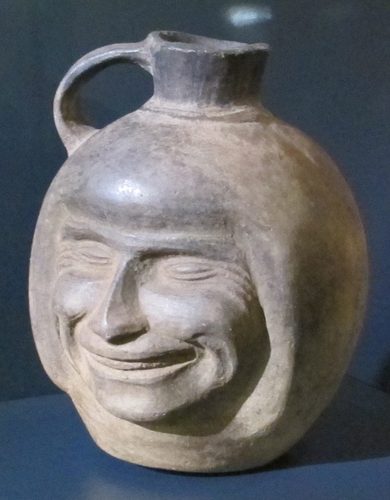
Maya vessels were painted in reds, oranges, and black with courtly scenes, ballgame players, and mythological narrative, functioning as both fine art and readable text, while Andean ceramics favored sculptural portrait vessels and stirrup-spout jars.
The story
Pre-Columbian art's roots reach back to the Olmec of Mexico's Gulf Coast, whose colossal carved stone heads and jade work, from around 1500 BCE, established motifs — the jaguar, the feathered serpent — that echoed through later Mesoamerican cultures for two thousand years. In the centuries that followed, city-states across Mesoamerica and complex societies across the Andes built monumental religious architecture, developed writing and calendar systems, and organized elaborate court art tied to sacred kingship.
The Maya city-states reached an artistic high point between roughly 250 and 900 CE, raising stone temple-pyramids at sites like Tikal and Palenque and carving detailed historical inscriptions on stelae. Centuries later, the Aztec (Mexica) empire, from its island capital Tenochtitlan, absorbed and reworked earlier Mesoamerican traditions into a grand imperial art of stone sculpture, featherwork, and gold. In the Andes, the Inca empire, expanding rapidly in the 1400s, unified diverse regional textile and metalworking traditions under a state architecture of precisely fitted stonework and an administrative system recorded on knotted khipu cords rather than a script.
This independent development ended abruptly: Spanish forces captured the Inca ruler Atahualpa in 1532, and within decades conquest, disease, and colonization dismantled the political structures that had sustained this art, though many craft traditions persisted and adapted under colonial rule.
Timeline
- 1,500 BCEOlmec culture emerges on Mexico's Gulf Coast
- 900 BCEc. 900 BCE Olmec colossal stone heads carved on Mexico's Gulf Coast
- 250 CEMaya Classic period begins, cities like Tikal flourish
- 450 CEc. 450 Teotihuacan reaches its height as a major urban center
- 1200Inca state takes shape in the Cusco valley
- 1325Aztecs found their capital, Tenochtitlan
- 1438Inca Empire expands rapidly under Pachacuti
- 1532Spanish forces capture the Inca ruler Atahualpa
Works to know
| Work | Maker | Date | Why it matters |
|---|---|---|---|
| Colossal Olmec Heads | Unknown | c. 900–400 BCE | Multi-ton basalt portrait heads carved with individualized features, likely depicting rulers, among the earliest large-scale sculpture in the Americas. |
| Bonampak Murals | Unknown | c. 790 CE | Vividly painted Maya wall murals depicting a royal court, battle, and ritual scene, among the best-preserved narrative paintings of the ancient Americas. |
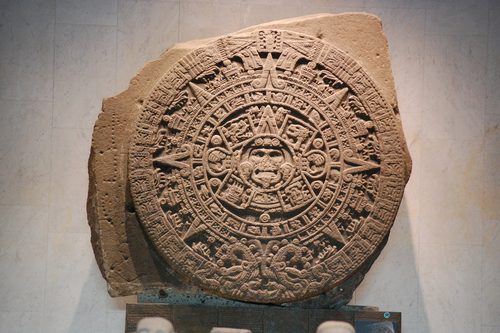
| Aztec Sun Stone | Unknown | c. 1502–1521 | A massive carved basalt disk combining calendar symbolism and cosmological imagery, created for the Aztec capital Tenochtitlan. |
| Machu Picchu | Unknown | c. 1450 | An Inca royal estate of precisely fitted dry-stone architecture set high in the Andes, exemplifying Inca engineering and site planning. |
| Paracas Textiles | Unknown | c. 100 BCE–200 CE | Elaborately embroidered burial textiles from Peru's south coast, prized for their dense, vividly colored figural patterning and technical range. |
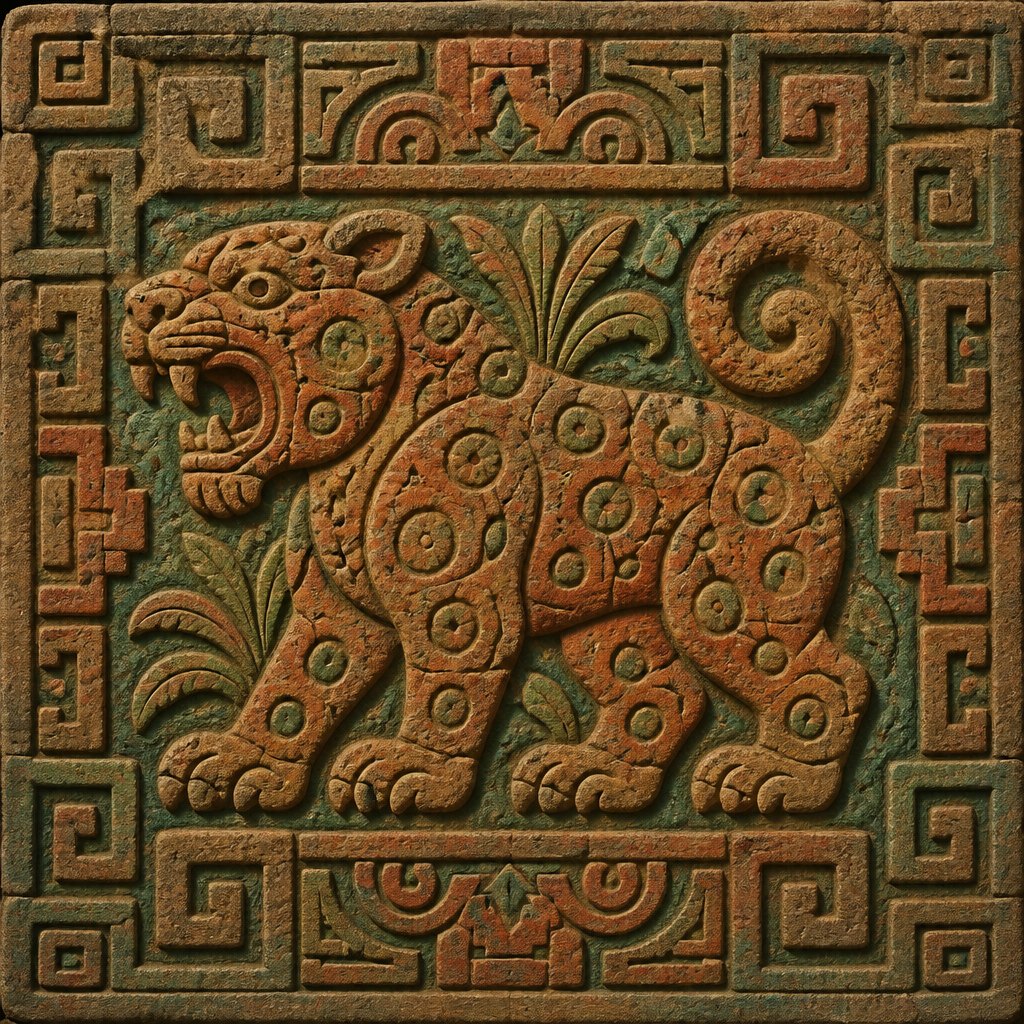 AI-generated
Make it yourself
Create art in the Pre-Columbian Art spirit
This interpretation was generated from a prompt like: “A carved stone relief panel showing a stylized jaguar and geometric step-fret border, warm terracotta and jade-green pigment worn into deep grooves, flat frontal composition, dense repeating pattern, weathered stone surface, dramatic raking light.”
Open the Pre-Columbian Art Style generator →How to evoke the period
Favor bold, flat geometric pattern and stylized, angular figures over naturalistic modeling — profile faces, symmetrical repeating borders, and stepped or interlocking shapes read as immediately recognizable. Build compositions around a central motif, such as a stylized animal or sun form, framed by registers of smaller repeating symbols. Use a warm, earthy palette: terracotta, deep gold, jade green, and rich red-brown against stone gray or woven cream. Suggest material surface through texture — carved stone relief, woven fiber, or hammered metal sheen — rather than painterly blending. Architecture should read as massive, stepped, and stone-built, oriented toward sky and horizon.
What it left behind
Pre-Columbian visual language never fully disappeared: Indigenous communities across Mexico, Central America, and the Andes carried weaving, ceramic, and metalworking traditions through colonization into the present, and twentieth-century Mexican muralists drew directly on Aztec and Maya imagery to build a national visual identity. Andean textile techniques and motifs remain living crafts today. Archaeological rediscovery of sites like Machu Picchu and Palenque, and the decipherment of Maya glyphs in the twentieth century, reshaped how these civilizations are understood — not as vanished mysteries but as literate, sophisticated societies whose descendants remain part of the Americas.
Frequently asked questions
What is Pre-Columbian art?
Pre-Columbian art refers to the art of Indigenous American civilizations before sustained European contact, including the Olmec, Maya, Aztec, and Inca, spanning roughly 1500 BCE to 1532 CE across Mesoamerica and the Andes.
When was the Pre-Columbian period?
The Pre-Columbian period spans from around 1500 BCE, with the rise of Olmec culture, to 1532 CE, when Spanish forces captured the Inca ruler Atahualpa, ending the last major independent Indigenous American empire.
What materials did Pre-Columbian artists use?
Artists worked in carved stone, painted stucco, polychrome ceramics, gold, silver, and copper, woven cotton and wool textiles, and iridescent feathers, often without metal tools, the wheel, or draft animals.
Did the Maya, Aztec, and Inca share an art style?
No — they were distinct cultures with their own styles, languages, and histories, though Mesoamerican groups like the Maya and Aztec shared some motifs, such as feathered serpents, through centuries of regional contact.