 Art
Art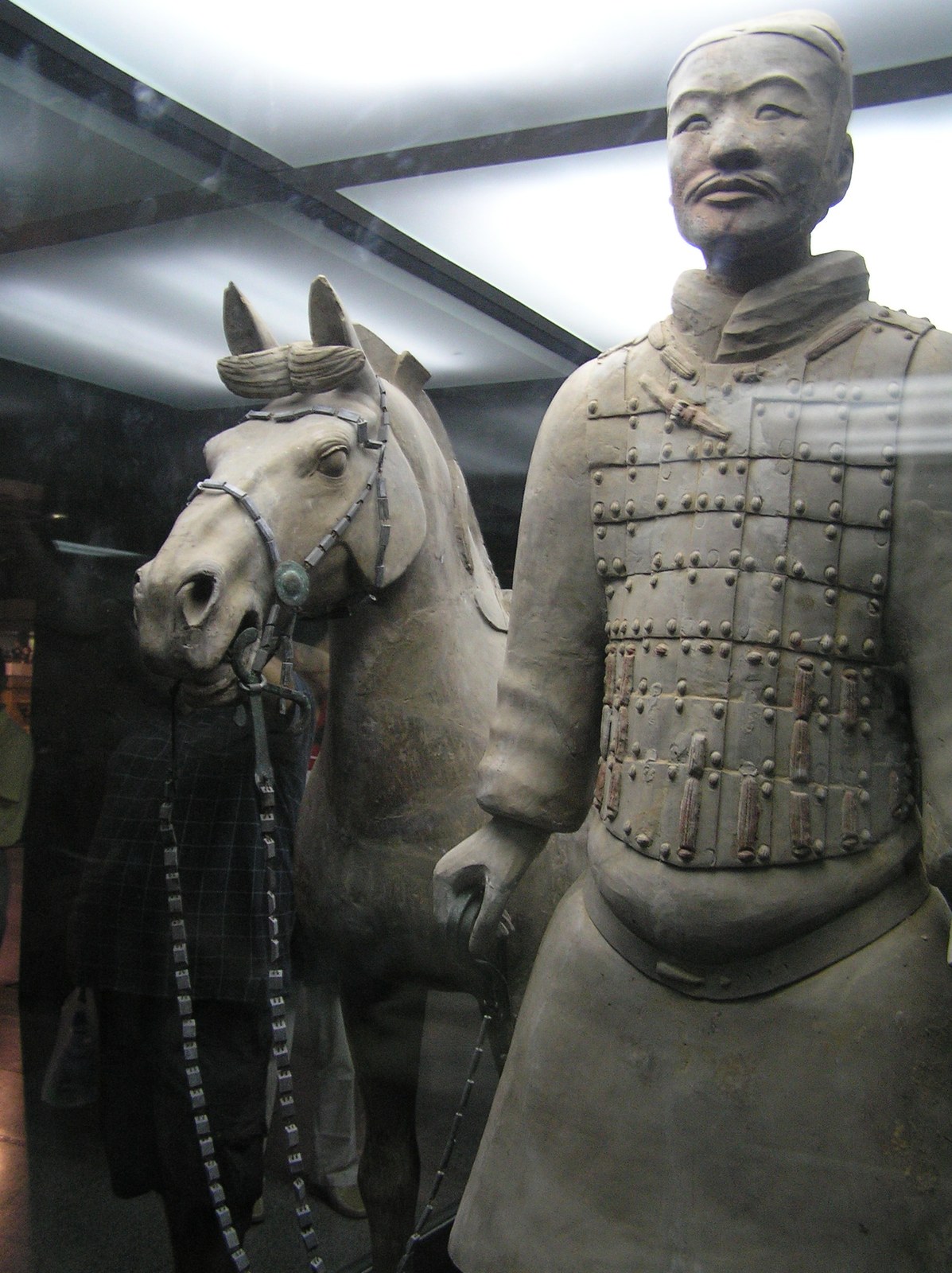
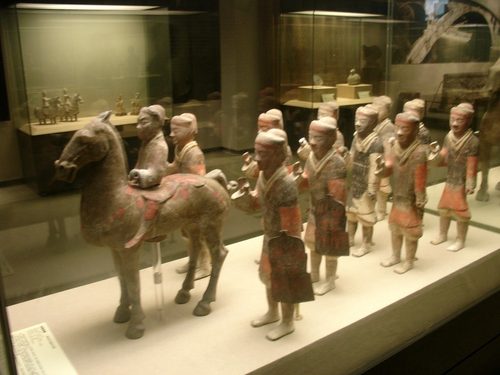
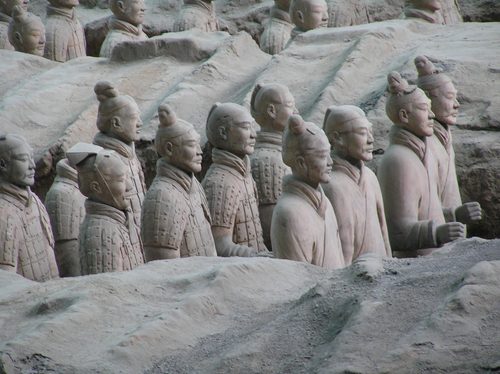
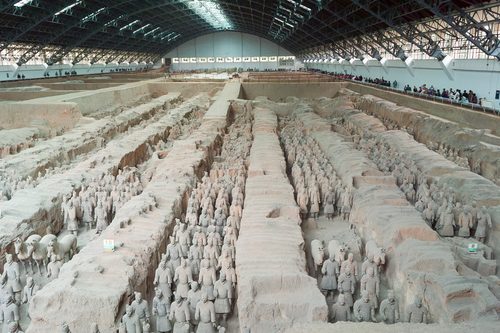
Ancient Chinese art covers the art of China's earliest historical dynasties, from the Shang dynasty's rise around 1600 BCE to the fall of the Han dynasty in 220 CE, spanning the Shang, Zhou, Qin, and Han periods. Much of what survives was made for ritual and burial rather than display: cast bronze vessels used in ancestor worship, carved jade objects buried with the dead, and tomb complexes stocked with goods, models, and figures meant to serve the deceased in the afterlife. Patronage centered on royal and noble courts, who commissioned bronze workshops capable of extraordinary technical precision, and later, under unified empires, on the state itself, which could mobilize labor on an enormous scale — most famously for the buried terracotta army guarding China's first emperor. Across these centuries, a consistent thread is the connection between art, ancestor reverence, and cosmic order: bronze vessels bore inscriptions recording lineage and achievement, jade was prized for qualities believed to protect the body after death, and even everyday forms like the ritual disc and blade carried symbolic weight. By the Han dynasty, trade along early Silk Road routes and a more settled bureaucratic empire brought new subjects and materials into an art still tied, at its core, to family, ancestry, and state authority.
The look: what defines Ancient Chinese Art
Ritual bronze vessels
Shang and Zhou bronze casters produced elaborate ritual vessels for wine and food offerings, covered in dense geometric and animal-mask (taotie) motifs cast using sophisticated piece-mold techniques, often inscribed with dedications to ancestors.
Jade carving
Jade was worked, not carved with metal but ground slowly with abrasive sand, into ritual discs (bi) and tubes (cong), prized for a hardness and cool luster believed to protect and preserve the body in burial.
Oracle bone inscriptions
Shang diviners inscribed questions and answers on turtle shells and ox bones, then read cracks from applied heat; the resulting inscriptions are China's earliest known writing, combining record-keeping with sacred practice.
Terracotta burial figures
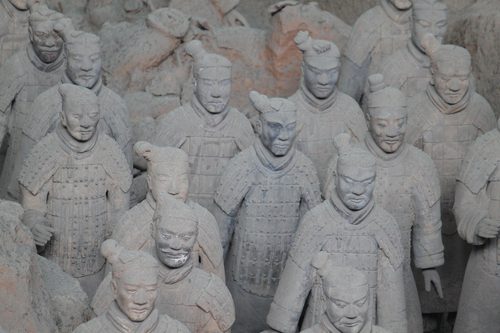
Tomb art included ranks of life-sized or miniature clay figures — soldiers, servants, animals — made to accompany and serve the dead, reaching a spectacular scale in the buried army guarding China's first emperor.
Lacquerware and silk
Han-era craftsmen produced fine lacquered wood objects, built up in many thin painted layers for a glossy, durable surface, alongside woven and painted silk textiles traded widely along expanding overland trade routes.
Symbolic animal motifs
Dragons, phoenixes, and other symbolic creatures recur across bronze, jade, and tomb art, tied to cosmology and status; the taotie mask, a stylized animal face, remains one of the era's most distinctive motifs.
The story
Ancient Chinese art begins in the archaeological record with the Shang dynasty, established by around 1600 BCE, whose royal centers produced elaborately cast bronze ritual vessels and the oracle-bone inscriptions that record China's earliest writing. Bronze casting under the Shang and the Zhou dynasty that followed reached extraordinary technical sophistication, with vessels serving ancestor-worship rituals central to royal legitimacy.
The Zhou dynasty, China's longest, introduced the political idea of the Mandate of Heaven — that a ruler's authority depended on virtuous governance — and its long, fragmented later centuries, marked by rival states, saw bronze work grow more varied and jade carving flourish alongside new philosophical traditions.
China's political unification under the short-lived Qin dynasty in 221 BCE brought centralized state power to art on an unprecedented scale: the first emperor's tomb complex, guarded by thousands of individualized terracotta soldiers, remains the era's most staggering undertaking, a demonstration of imperial control over labor and craft alike.
The Han dynasty that followed stabilized and expanded the empire for four centuries, opening trade routes westward and developing painted lacquerware, silk textiles, and elaborate tomb art for a broader elite. Han rule ended in 220 CE amid political fragmentation, closing the ancient period and opening China's long medieval age of division and reunification.
Timeline
- 1,600 BCEc. Shang dynasty established, earliest bronze ritual vessels cast
- 1,200 BCEc. Oracle bone inscriptions record China's earliest writing
- 1,046 BCEc. Zhou dynasty overthrows the Shang
- 475 BCEc. Warring States period begins amid Zhou political fragmentation
- 221 BCEQin dynasty unifies China under its first emperor
- 210 BCEc. Terracotta Army buried near the First Emperor's tomb
- 206 BCEHan dynasty founded after Qin collapse
- 220 CEHan dynasty falls, ending the ancient period
Works to know
| Work | Maker | Date | Why it matters |
|---|---|---|---|
| Terracotta Army | Unknown | c. 210 BCE | Thousands of individualized life-sized clay soldiers buried near the tomb of Qin Shi Huang, China's first emperor, to guard him in the afterlife. |
| Houmuwu Ding | Unknown | c. 1200 BCE | Massive Shang-dynasty bronze ritual vessel, among the largest ancient bronzes known, cast for royal ancestor-worship ceremonies. |
| Jade Cong and Bi Discs | Unknown | c. 3300–1000 BCE | Ground jade ritual objects — flat discs and tubular forms — buried with elites, prized for material qualities believed to protect the body after death. |
| Painted Silk Banner, Tomb of Lady Dai | Unknown | c. 168 BCE | Painted silk funerary banner from a Han-dynasty tomb at Mawangdui, depicting the afterlife journey of an aristocratic woman in vivid detail. |
| Oracle Bones of Anyang | Unknown | c. 1200 BCE | Inscribed turtle shells and ox bones used for royal divination, preserving China's earliest known writing system. |
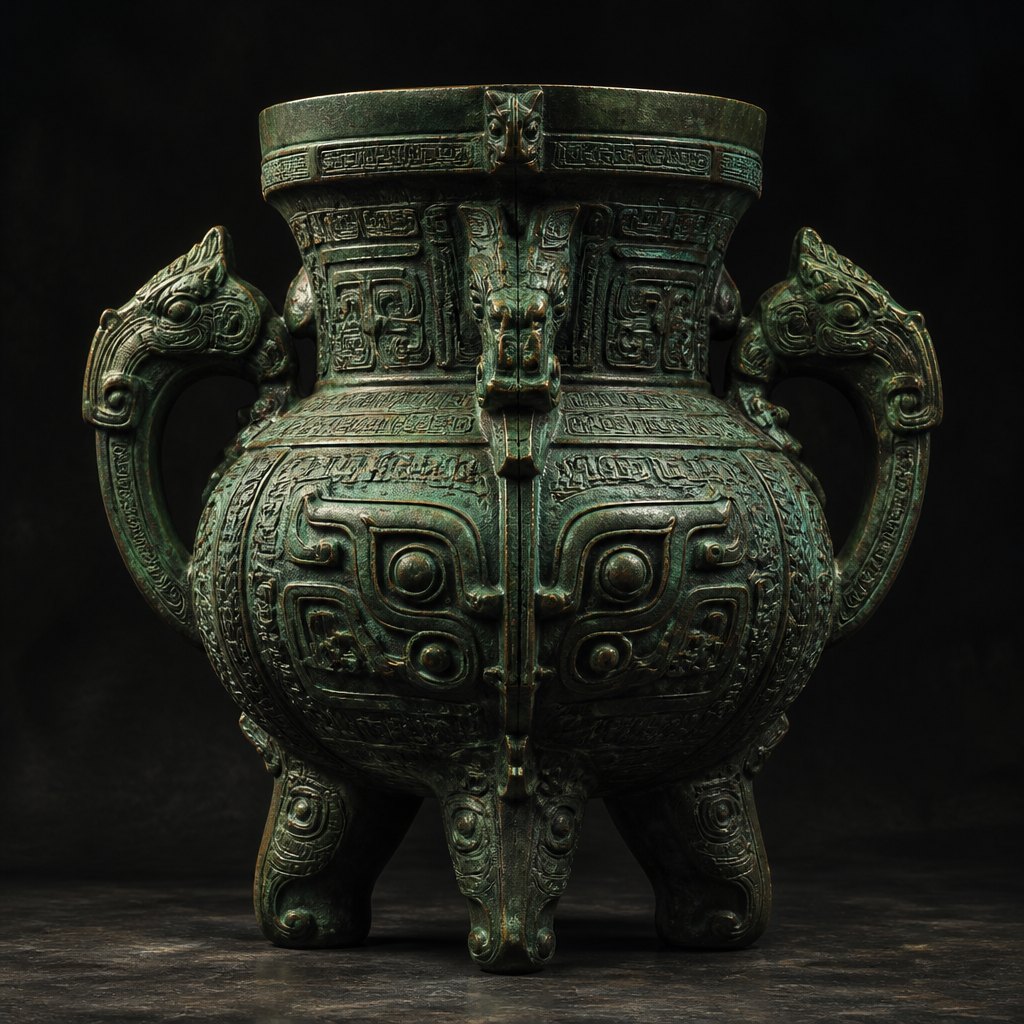 AI-generated
Make it yourself
Create art in the Ancient Chinese Art spirit
This interpretation was generated from a prompt like: “A cast bronze ritual vessel with dense geometric and stylized animal-mask relief patterns, footed symmetrical form, deep jade-green patina, warm bronze highlights, set against a plain dark ceremonial backdrop.”
Open the Ancient Chinese Bronze Art Style generator →How to evoke the period
To evoke ancient Chinese art, favor bronze-toned metallics and deep jade greens, worked into dense, repeating geometric or stylized animal-mask patterns rather than open space. Ritual vessel shapes — footed, handled, symmetrical — make strong central forms; render surfaces as cast relief rather than flat paint. For tomb-inspired imagery, arrange rows of similar figures or objects, each individualized in small details, suggesting careful ceremonial repetition. Jade-style objects should read as smooth, cool, and precisely ground rather than roughly carved. Add stylized dragon, phoenix, or spiral cloud motifs as border or surface decoration, and keep compositions symmetrical and grounded, reflecting order and ancestral respect rather than spontaneity.
What it left behind
Ancient Chinese art established materials, forms, and values that shaped Chinese art for the next two thousand years: bronze ritual vessels as vehicles for ancestor reverence, jade as a material of moral and spiritual weight, and tomb art as a serious artistic undertaking rather than an afterthought. The taotie mask and dragon motif recur across later Chinese decorative art in painting, ceramics, and architecture. The scale and organization behind projects like the terracotta army set a template for state-sponsored art as a demonstration of imperial power. Han-dynasty trade routes westward also opened the exchanges that would carry Chinese art, and materials like silk, toward the wider world.
Frequently asked questions
What is ancient Chinese art?
Ancient Chinese art refers to the art of China's earliest dynasties — Shang, Zhou, Qin, and Han — from about 1600 BCE to 220 CE, including ritual bronzes, jade carving, oracle bone inscriptions, and tomb art.
Why are bronze vessels so important in ancient Chinese art?
Bronze vessels held food and wine offerings in ancestor-worship rituals central to royal legitimacy; their inscriptions recorded lineage and achievement, making them both sacred objects and historical documents.
What is the Terracotta Army?
The Terracotta Army is a vast buried force of individualized life-sized clay soldiers created to guard the tomb of Qin Shi Huang, China's first emperor, discovered in the twentieth century near Xi'an.
Why was jade so valued in ancient China?
Jade was prized for its hardness, cool touch, and durability, qualities believed to protect and preserve the body after death; it required slow abrasive grinding rather than carving, making finished pieces highly labor-intensive.