 Art
Art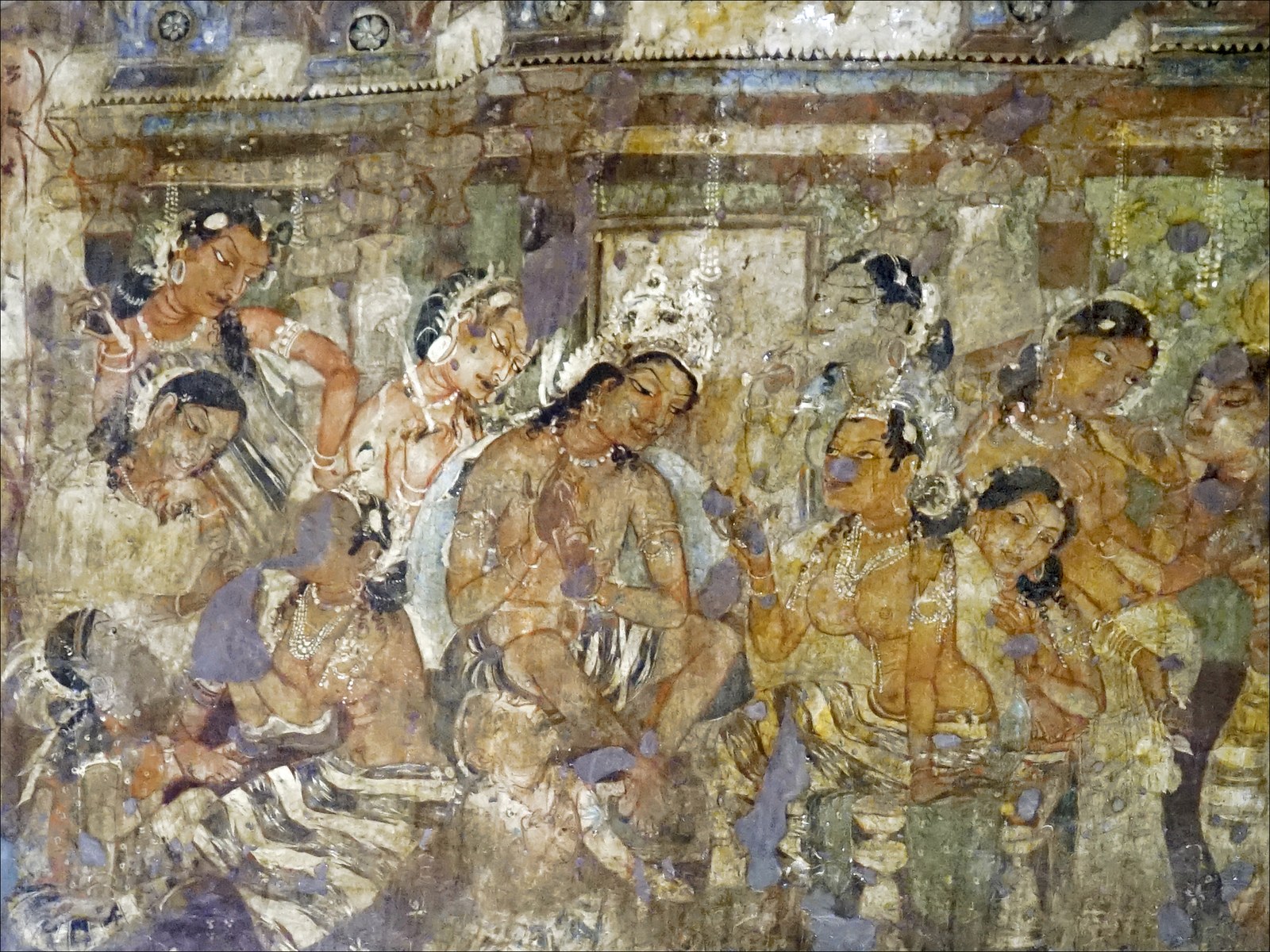
Ancient Indian art covers roughly nine centuries of sculpture, architecture, and painting across the Indian subcontinent, from the rise of the Maurya Empire around 321 BCE to the waning of the Gupta Empire around 550 CE. It was made largely for two overlapping patrons: emperors asserting authority over a vast, diverse territory, and the Buddhist, Jain, and Hindu religious communities those emperors supported. Ashoka's Maurya court raised polished sandstone pillars carrying edicts on ethical rule, giving the era its first monumental stone-carving tradition. As Buddhism spread along trade routes, stupas rose as reliquary mounds ringed with narrative gateways, and later, under the Kushan Empire, contact with Hellenistic craftsmen in the northwest gave rise to the Gandhara school, one of the first traditions to show the Buddha in human form. By the Gupta centuries, indigenous workshops at Sarnath and Mathura had absorbed these currents into a calmer, more classical idiom, while cave temples in the Deccan filled with mural painting. Across all of it, art served as a bridge between royal legitimacy, mercantile wealth from trade, and the era's competing religious devotions.
The look: what defines Ancient Indian Art
Polished Ashokan pillars
Single shafts of sandstone, quarried whole and raised across the empire, carry Ashoka's edicts below a mirror-bright polish. Many end in an animal capital, most famously the four lions now on India's national emblem.
Aniconic early symbols
Before the Buddha was shown in human form, sculptors stood for his presence with a wheel, an empty throne, a pair of footprints, or the bodhi tree, letting the absence itself carry religious weight.
Narrative gateway relief
Stupa gateways, or toranas, are carved edge to edge with crowded, low-relief storytelling: jataka tales, royal processions, elephants and traders, turning a monument's threshold into a continuous picture-book of devotion and daily life.
Rock-cut cave sanctuaries
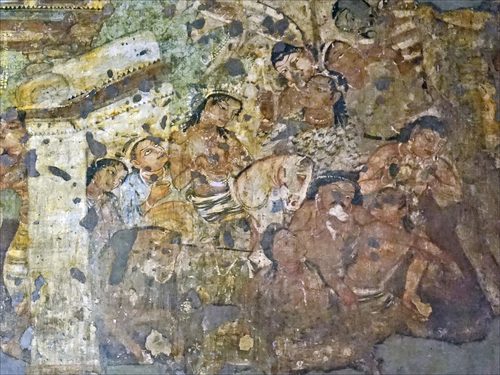
Chaityas and viharas were hollowed directly from hillsides, their carved facades imitating timber architecture in stone. Inside, columned halls and painted walls created cool, dim spaces for worship and monastic life.
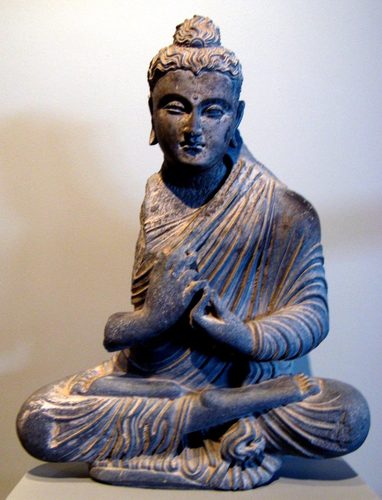
Gandhara's Hellenistic Buddha
In the northwest, Kushan-era workshops gave the Buddha wavy hair, a toga-like robe with naturalistic folds, and a face indebted to Hellenistic sculpture, fusing Greco-Roman modeling with Indian religious subject matter.
Gupta classical serenity
Later Sarnath and Mathura sculptors smoothed Gandhara's foreign accent into a calmer native ideal: half-closed eyes, a faint smile, and transparent, cling-to-the-body drapery rendered as fine, even ripples across the stone.
The story
Ancient Indian art begins with empire. Around 321 BCE, Chandragupta Maurya unified much of the subcontinent, and his grandson Ashoka, ruling from roughly 268 to 232 BCE, converted to Buddhism and used stone for the first time at monumental scale: polished edict pillars and the Great Stupa at Sanchi, spreading a new visual language of royal patronage yoked to religious teaching.
After the Mauryas fragmented, regional dynasties kept building: Sanchi's gateways were added under the Shungas and Satavahanas, dense with carved narrative. Trade brought new contact. The Kushan Empire, ruling the northwest and Central Asia from around the 1st century CE, connected Indian workshops to Hellenistic and Central Asian craftsmen, and the Gandhara school emerged alongside the indigenous Mathura school, two answers to the same new question of how to depict the Buddha in human form.
The Gupta Empire, founded around 320 CE, is often called ancient India's classical age. Courts at Sarnath and centers across the north supported sculpture that fused Gandhara's realism with Mathura's warmth into a serene, widely copied ideal. In the Deccan, cave temples were carved and painted with jataka narratives in mineral tempera. By the empire's decline around 550 CE, this Gupta idiom had already begun traveling outward along trade and pilgrimage routes, setting a template for Buddhist art across Asia.
Timeline
- 321 BCEChandragupta Maurya founds the Maurya Empire
- 268 BCEc. Ashoka's reign begins, turning stone into imperial medium
- 250 BCEc. Ashokan edict pillars and the Great Stupa at Sanchi raised
- 100 BCEc. carved gateways added to the Great Stupa at Sanchi
- 100 CEc. Gandhara and Mathura schools flourish under Kushan rule
- 320 CEGupta Empire founded, ushering in a classical age
- 475 CEc. Ajanta cave murals painted in the Deccan
- 550 CEGupta Empire declines
Works to know
| Work | Maker | Date | Why it matters |
|---|---|---|---|
| Lion Capital of Ashoka | Unknown | c. 250 BCE | Four addorsed lions atop a polished pillar at Sarnath; adopted as modern India's national emblem. |
| Great Stupa at Sanchi | Unknown | 3rd century BCE–1st century CE | Ashoka's original mound, later ringed with four carved gateways narrating the Buddha's life and past births. |
| Standing Buddha of Gandhara | Unknown | c. 1st–3rd century CE | Kushan-era sculpture showing the Buddha with Hellenistic drapery and wavy hair, among the earliest human images of him. |
| Seated Buddha of Sarnath | Unknown | c. 5th century CE | Gupta-era sandstone image with a serene half-smile and finely carved halo; a template copied across Buddhist Asia. |
| Ajanta Cave paintings | Unknown | c. 5th century CE | Mural cycles inside rock-cut caves depicting jataka tales, among the finest surviving ancient Indian paintings. |
| Iron Pillar of Delhi | Unknown | c. 400 CE | A rust-resistant forged-iron column from the Gupta period, prized as a metallurgical achievement. |
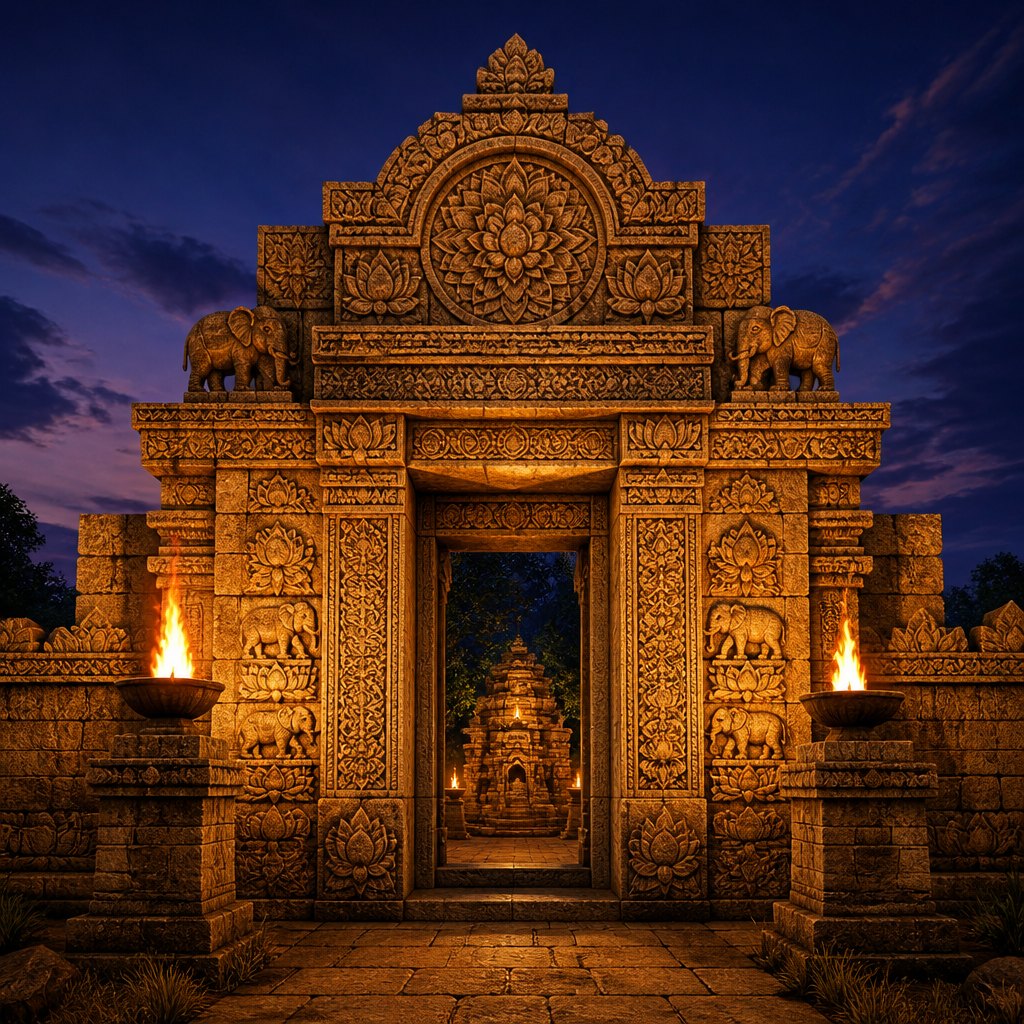 AI-generated
Make it yourself
Create art in the Ancient Indian Art spirit
This interpretation was generated from a prompt like: “A weathered sandstone temple gateway carved with dense lotus rosettes, elephants, and geometric relief bands, lit by warm torchlight against a deep indigo dusk sky, textured stone surface, ochre and gold tones, symmetrical composition.”
Open the Ancient Indian Mural Art Style generator →How to evoke the period
Lean on stone and cave textures rather than paint-smooth surfaces: sandstone tan and terracotta red, warmed with gold-leaf accents. Center a single serene figure, eyes half-closed, faint smile, drapery rendered as fine, evenly spaced ripples, inside a carved halo or an architectural niche. Fill borders with dense, low-relief bands: lotus rosettes, elephants, geometric rope patterns, or a procession frieze. Favor frontal or three-quarter symmetry and generous negative space around the central form. For a rock-cut mood, add torch-lit shadow, chisel-mark texture, and a cool, dim cave-interior palette throughout the whole scene.
What it left behind
Gupta-era Buddha imagery, with its serene expression and clinging drapery, became the template that traveled with Buddhism into Central Asia, China, Southeast Asia, and Japan, shaping how the figure was rendered for centuries afterward. Ashoka's lion capital sits today as independent India's national emblem, and stupa architecture set a pattern still visible in temple mounds and gateways across Asia. The narrative relief carved into Sanchi's gateways established storytelling-in-stone as an enduring Indian convention, later echoed in temple sculpture. Cave-temple painting at Ajanta demonstrated a mural technique later generations returned to study and restore.
Frequently asked questions
What is Ancient Indian art?
It is the sculpture, architecture, and painting produced across the Indian subcontinent from the Maurya Empire (c. 321 BCE) through the Gupta Empire (to c. 550 CE), including Buddhist stupas, Gandhara and Gupta Buddha imagery, and cave-temple murals.
When was the Gupta period?
The Gupta Empire ruled from around 320 CE to about 550 CE, a stretch often called ancient India's classical age for its sculpture, literature, and cave-temple painting.
What is Gandhara art?
Gandhara art is a Buddhist sculptural style from the northwest subcontinent, roughly 1st–3rd century CE under Kushan rule, blending Hellenistic modeling and drapery with Indian religious subject matter.
Why don't early Buddhist artworks show the Buddha?
Early Buddhist art was aniconic: sculptors represented the Buddha's presence through symbols like an empty throne, footprints, or a wheel rather than a human figure, a convention that changed only later.