 Art
Art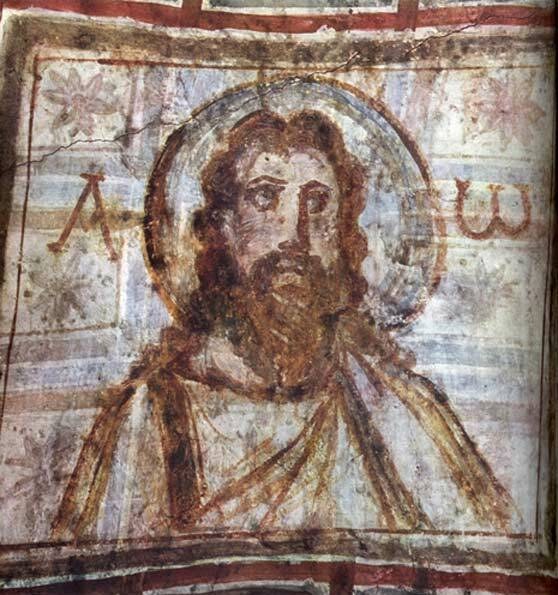
Early Christian art is the visual culture of the new religion as it grew across the Roman Mediterranean world, from roughly 200 CE, when the earliest identifiable Christian imagery appears in Roman catacombs, to the early sixth century, by which point church-building and mosaic decoration were well established. It was made first in secret and for the dead: modest catacomb paintings and carved sarcophagi used coded symbols, a fish, a shepherd carrying a lamb, a dove, an anchor, legible to believers but safely ambiguous to outsiders during periods of persecution. Everything changed after Constantine's Edict of Milan in 313 CE legalized Christianity, and imperial patronage turned a persecuted sect's private imagery into public architecture almost overnight. Roman basilicas, a civic building type, were repurposed as church plans, their interiors filled with gold-ground mosaic narrating biblical history for congregations who could not read. Artists borrowed freely from Roman imperial imagery, the enthroned ruler, the triumphal procession, and reused it to depict Christ and the saints, fusing classical technique with an entirely new subject.
The look: what defines Early Christian Art
Coded funerary symbols
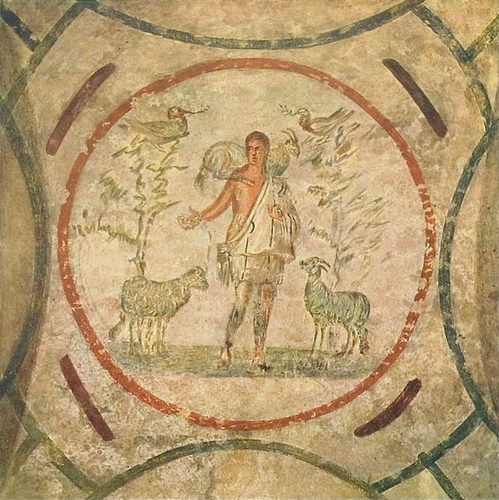
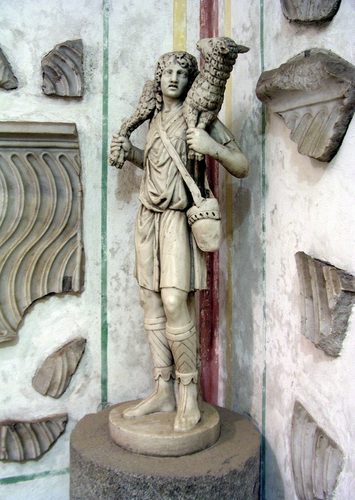
Before public worship was legal, catacomb art relied on symbols outsiders wouldn't recognize: a fish for Christ, an anchor for hope, a dove for peace, and a shepherd carrying a lamb standing in for Christ himself.
Catacomb ceiling painting
Underground burial chambers were decorated with simple frescoes in red and ochre outline, figures rendered flat and schematic rather than modeled, prioritizing a legible symbol over naturalistic likeness, painted quickly on damp plaster in cramped tunnels.
Basilica church plan
Borrowing the Roman civic basilica's long nave and rounded apse, early churches oriented worshippers toward an altar, with a colonnaded interior that funneled light and attention forward rather than up.
Gold-ground mosaic
Walls and domes were sheathed in glass tesserae set at angles to catch light, gold backgrounds dissolving any sense of real space so sacred figures seemed to float in eternity rather than a room.
Sarcophagus relief narrative
Marble sarcophagi were carved with tightly packed biblical scenes in continuous registers, reusing older Roman relief conventions but replacing myth with episodes from Hebrew scripture and the life of Christ himself.
Reused imperial imagery
Christ was often shown enthroned and youthful, borrowing the pose and dress of a Roman emperor or philosopher, a visual shorthand for divine authority that was already familiar to Roman eyes.
The story
Christian art begins underground. From around 200 CE, believers in Rome decorated catacomb tombs with simple frescoes using coded symbols rather than direct portrayals of Christ, a caution suited to a faith still subject to periodic Roman persecution.
The turning point came in 313 CE, when Constantine's Edict of Milan legalized Christianity. Imperial and private patronage now flowed openly, and Rome's civic basilica plan, a long hall suited to public assembly, became the template for church architecture. Old St. Peter's Basilica and other major churches rose across the fourth century, their walls given over to mosaic and fresco narrating scripture for congregations.
Patronage soon spread beyond Rome. In Ravenna, a western capital by the early fifth century, mosaic workshops produced some of the era's finest surviving interiors, blending Roman technique with an increasingly formal, symbolic visual language. Sarcophagus carving continued the shift from private symbol to public biblical narrative, seen in tightly packed relief scenes of scripture.
By the early sixth century, this visual language, gold-ground mosaic, frontal enthroned figures, basilica architecture, was fully formed and would carry directly into Byzantine art in the east and into medieval church decoration across the former empire.
Timeline
- 200 CEc. earliest identifiable Christian catacomb paintings appear in Rome
- 250 CEDecian persecution intensifies pressure on Christian communities
- 313 CEEdict of Milan legalizes Christianity across the Roman Empire
- 320 CEc. Old St. Peter's Basilica begun in Rome
- 359 CESarcophagus of Junius Bassus carved in Rome
- 425 CEc. Mausoleum of Galla Placidia built in Ravenna
- 432 CESanta Maria Maggiore's nave mosaics begun in Rome
Works to know
| Work | Maker | Date | Why it matters |
|---|---|---|---|
| Catacomb of Priscilla frescoes | Unknown | c. 3rd century CE | Underground Roman burial paintings featuring some of the earliest known depictions of the Good Shepherd and orant figures. |
| Sarcophagus of Junius Bassus | Unknown | c. 359 CE | Marble sarcophagus carved with tightly arranged biblical scenes in two registers, a landmark of early narrative relief. |
| Santa Costanza mausoleum mosaics | Unknown | c. 350 CE | Ceiling mosaics combining classical vine-harvest imagery with early Christian symbolism in a domed Roman mausoleum. |
| Santa Maria Maggiore mosaics | Unknown | 432–440 CE | Nave and arch mosaics narrating Old Testament and infancy narratives in one of Rome's grandest basilicas. |
| Mausoleum of Galla Placidia | Unknown | c. 425–450 CE | Ravenna mausoleum famed for its star-strewn blue dome and Good Shepherd mosaic, a peak of early mosaic art. |
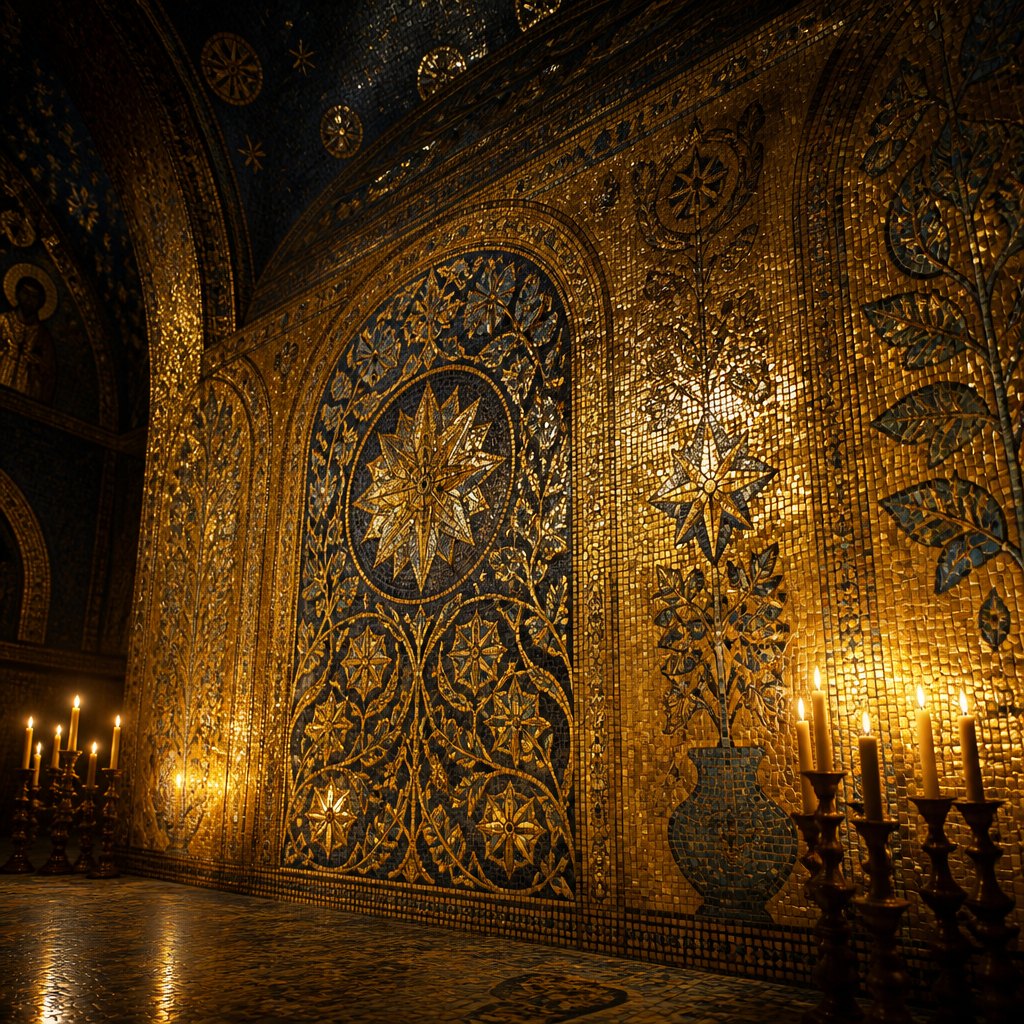 AI-generated
Make it yourself
Create art in the Early Christian Art spirit
This interpretation was generated from a prompt like: “A church interior wall sheathed in gold glass mosaic tesserae arranged in geometric vine and star patterns, warm flickering candlelight, shimmering uneven surface, deep blue and gold tones, low camera angle, quiet reverent atmosphere.”
Open the Early Christian Art Style generator →How to evoke the period
Work in gold, deep blue, and warm terracotta, with glass-tesserae texture for any mosaic-style surface. Flatten space deliberately: frontal, symmetrical figures against a shimmering gold or star-flecked ground, with no cast shadows or receding perspective. For a catacomb feel instead, use loose red-and-ochre outline sketches on rough, aged plaster, favoring simple symbols, an anchor, a dove, a shepherd's crook, over detailed scenes. Either way, keep forms calm, still, and hierarchical, with size indicating importance rather than realistic distance, and let light feel soft and unlocalized rather than directional or dramatic.
What it left behind
The basilica plan established here became the default shape of Western church architecture for over a millennium. Gold-ground mosaic set a visual standard Byzantine art would carry forward for centuries, while the symbolic shorthand developed in the catacombs, halo, shepherd, dove, remained legible in Christian art long after its coded origins were forgotten. Ravenna's mosaic workshops directly influenced Byzantine decoration to come. Even the habit of showing sacred figures enthroned and frontal, borrowed from Roman imperial portraiture, persisted as a default for depicting authority and holiness across medieval Europe.
Frequently asked questions
What is Early Christian art?
It is the art made by the early Christian community across the Roman Mediterranean, from catacomb paintings around 200 CE through public church mosaics of the early sixth century, moving from coded symbols to open biblical narrative.
When did Christian art become public?
Public Christian art became possible after 313 CE, when Constantine's Edict of Milan legalized the faith, allowing basilicas and mosaic-covered churches to be built openly for the first time.
Why did early Christians use symbols instead of images of Christ?
Under periods of Roman persecution, believers used coded imagery, like a fish or a shepherd, that carried meaning for insiders while appearing harmless or ambiguous to outsiders.
What is gold-ground mosaic?
It is wall or dome decoration made of angled glass tesserae backed with gold leaf, catching light to dissolve real space and set sacred figures against a shimmering, otherworldly background.