 Art
Art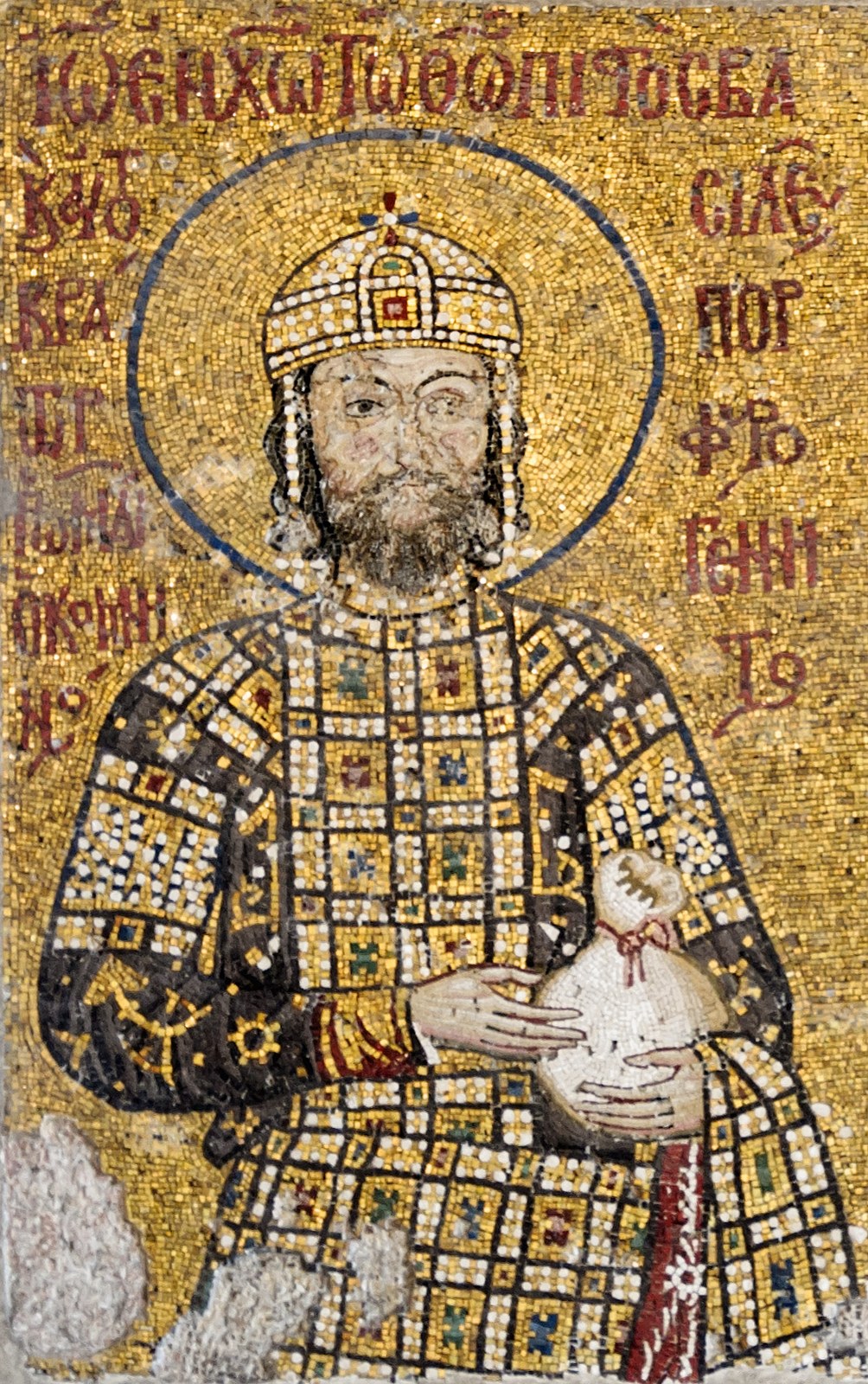
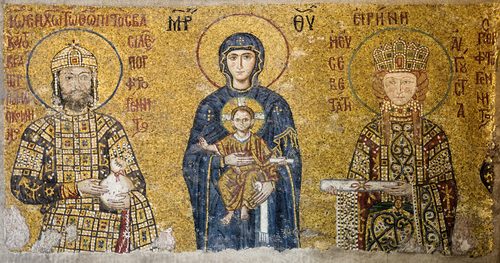
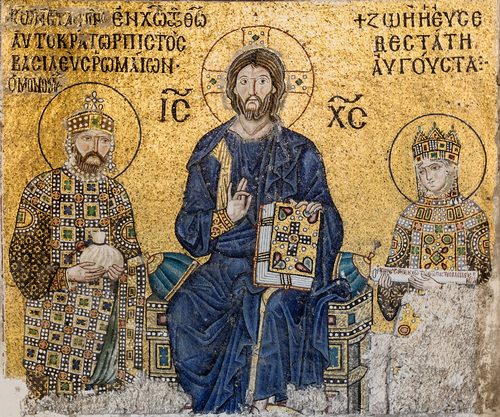
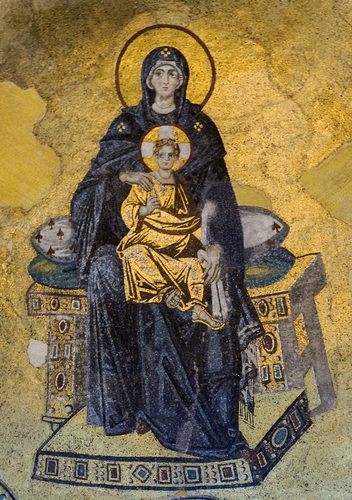
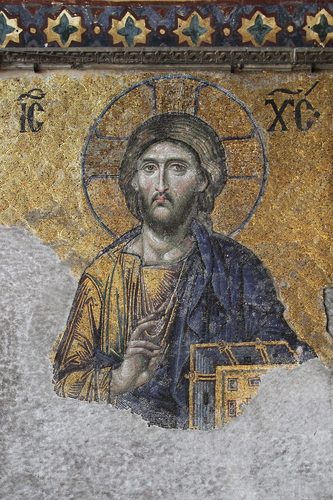
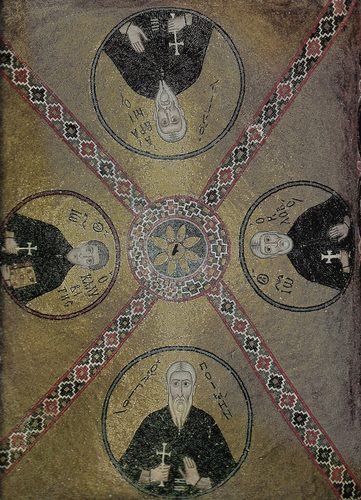
Byzantine art is the visual culture of the Eastern Roman Empire, centered on its capital Constantinople, from the city's founding in 330 CE to its fall to the Ottomans in 1453. Made chiefly for the imperial court and the Orthodox Church, it fused late Roman technique with an increasingly formal, spiritual aim: images were meant less to depict the physical world than to make the sacred present and approachable. Domed churches, epitomized by Hagia Sophia, replaced the basilica's long hall with centralized space meant to evoke heaven itself. Gold-ground mosaic and, later, painted wood icons showed Christ, the Virgin, and saints as frontal, elongated, and radiant, deliberately outside ordinary time and perspective. This visual language survived a fierce internal crisis, the eighth- and ninth-century controversy over whether religious images amounted to idolatry, which briefly destroyed enormous quantities of art before icons were restored. Despite the trauma of a crusader occupation in the thirteenth century, Byzantine workshops kept refining this style into the empire's final centuries, producing some of its most sophisticated painting shortly before Constantinople finally fell.
The look: what defines Byzantine Art
Centralized domed churches
Byzantine architects favored a domed, centralized plan over the basilica's long hall, crowning the space with a dome symbolizing heaven and often piercing its base with windows to flood the interior with light.
Frontal, elongated figures
Christ, the Virgin, and saints appear stiffly frontal with large eyes, elongated faces, and flattened bodies, a deliberate rejection of naturalism meant to signal a spiritual reality beyond ordinary appearance.
Gold-ground mosaic interiors
Interiors were sheathed floor to dome in glass and gold tesserae, set at angles to catch and scatter light, so figures seem to hover in a timeless golden field rather than real space.
Painted wood icons
Portable icons, painted in tempera on wood panel and often gilded, became objects of devotion in their own right, believed by some to offer a direct, prayerful connection to the figure depicted.
Purple and imperial color
Deep purple, once reserved for emperors, alongside gold and rich reds signaled rank and holiness alike; color coded meaning as strictly as pose or gesture did in Byzantine visual language overall.
Cross-in-square church plan
From the middle Byzantine period onward, churches were commonly built to a cross-in-square plan, a compact, domed design that soon became the standard export template across the wider Orthodox world.
The story
Byzantine art begins with a capital. Constantine dedicated Constantinople in 330 CE as a new Christian Rome in the east, and as the western empire eventually fell, this eastern half carried Roman administrative and artistic traditions forward under its own momentum. Justinian I's sixth-century building program, crowned by Hagia Sophia's vast dome, announced an art meant to awe as much as instruct.
The eighth and ninth centuries brought crisis: iconoclasm, a fierce debate over whether religious images were idolatrous, led to imperial bans and the destruction of countless icons and mosaics. When image veneration was formally restored in 843, the icon returned stronger than before, and centuries of relative stability let workshops refine mosaic and panel painting into a highly codified, confident style.
The Fourth Crusade's sack of Constantinople in 1204 was a severe blow, installing a Latin ruler and scattering artists and treasures. Byzantine rule resumed in 1261, and the empire's final two centuries, though politically diminished, produced some of its richest art, blending greater emotional expressiveness with the old formal vocabulary.
Constantinople fell to the Ottoman Empire in 1453, ending Byzantine political history, but its artistic conventions had already spread deep into Orthodox Christian regions, where icon painting and domed church architecture continued largely unbroken.
Timeline
- 330 CEConstantine dedicates Constantinople as the empire's new capital
- 537 CEHagia Sophia completed under Justinian I
- 547 CESan Vitale's mosaics completed in Ravenna
- 726 CEc. Iconoclasm begins, banning religious images
- 843 CEIcon veneration formally restored, ending iconoclasm
- 1204Fourth Crusade sacks Constantinople
- 1261Byzantine rule restored in Constantinople
- 1453Constantinople falls to the Ottoman Empire, ending the empire
Works to know
| Work | Maker | Date | Why it matters |
|---|---|---|---|
| Hagia Sophia | Isidore of Miletus and Anthemius of Tralles | 532–537 CE | Justinian's cathedral, its vast dome an engineering feat that defined centralized church architecture for centuries. |
| San Vitale mosaics (Justinian and Theodora panels) | Unknown | c. 547 CE | Ravenna mosaics showing the emperor and empress in ceremonial court dress, among the finest surviving Byzantine portraits in mosaic. |
| Christ Pantocrator icon, Saint Catherine's Monastery | Unknown | c. 6th century CE | One of the oldest surviving painted icons, showing Christ with an asymmetrical, dual-natured face; a foundational icon type. |
| Deësis mosaic, Hagia Sophia | Unknown | c. 1261 CE | A large mosaic of Christ flanked by the Virgin and John the Baptist, prized for its unusually soft, humanized modeling. |
| Chora Church mosaics and frescoes | Unknown | c. 1315–1321 CE | Constantinople's finest late Byzantine decoration, blending narrative detail and emotional expressiveness shortly before the empire's final century. |
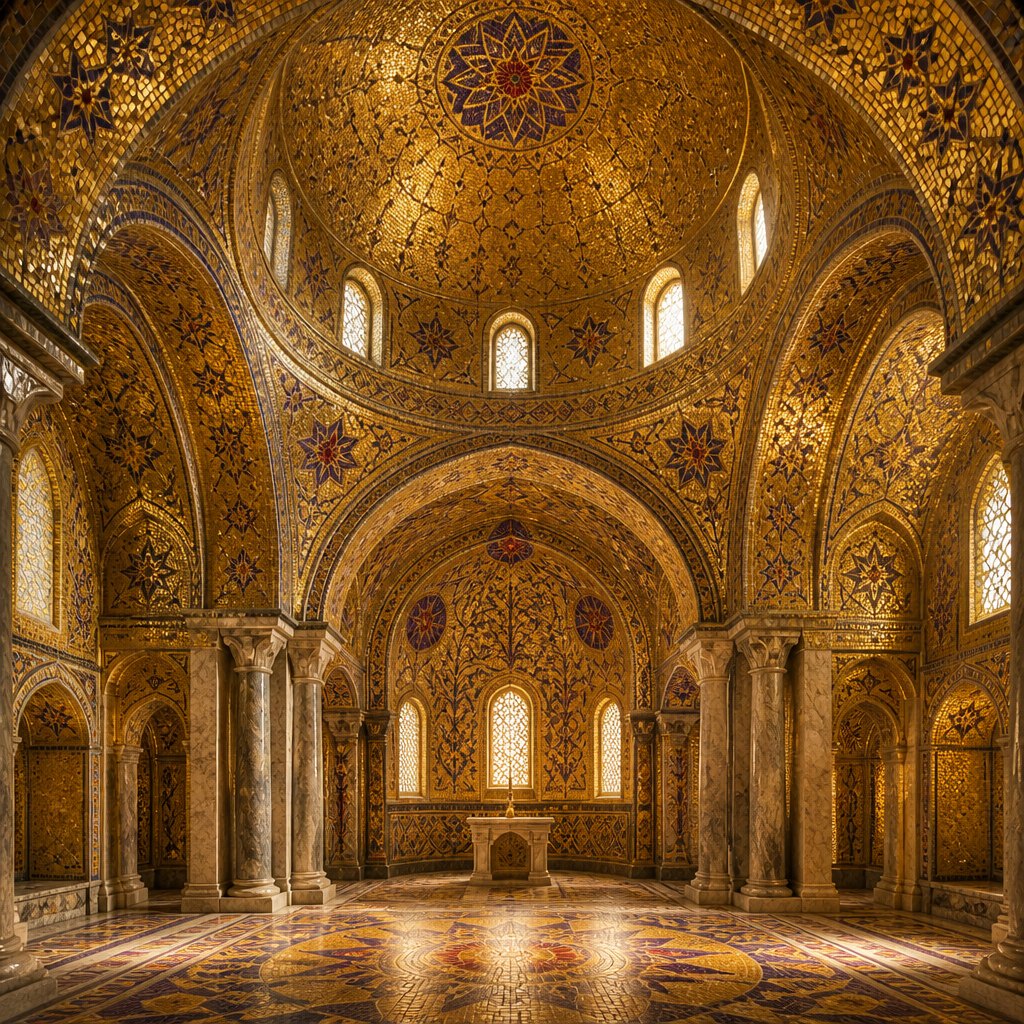 AI-generated
Make it yourself
Create art in the Byzantine Art spirit
This interpretation was generated from a prompt like: “An empty domed church interior sheathed in gold glass mosaic tesserae arranged in geometric star and vine patterns, diffuse light falling from high windows, deep purple and jewel-red accents, hushed golden atmosphere, ornate stonework.”
Open the Byzantine Art Style generator →How to evoke the period
Build compositions in gold, deep purple, and jewel-toned reds and blues, with a shimmering, uneven mosaic-tile texture across any background. Keep figures frontal, elongated, and still, with large eyes and simplified, flattened drapery rather than naturalistic anatomy. Use a flat gold field instead of a real setting, letting the subject float outside ordinary space and time. For a panel-icon look, add a raised gilded border and a slightly worn, aged wood-grain surface beneath the paint. Favor calm symmetry over dynamic movement; light should feel diffuse and otherworldly rather than directional.
What it left behind
Byzantine icon painting became, and remains, the living devotional art of Orthodox Christianity, its conventions of gold ground, frontal pose, and elongated form largely unbroken into the present. The domed, cross-in-square church plan spread across Eastern Europe, Russia, and the Balkans, defining Orthodox architecture for centuries after Constantinople fell. Byzantine mosaic and manuscript technique also fed directly into early Italian painting, ahead of the Renaissance's turn toward naturalism. Even the visual grammar of the halo and the frontal sacred portrait, refined here, persisted well beyond the empire's political end.
Frequently asked questions
What is Byzantine art?
It is the art of the Eastern Roman, or Byzantine, Empire, centered on Constantinople from 330 to 1453 CE, known for gold-ground mosaic, domed churches, and devotional icon painting.
When was the Byzantine Empire?
The Byzantine Empire lasted from 330 CE, when Constantinople was founded, to 1453 CE, when the city fell to the Ottoman Empire.
What was iconoclasm?
Iconoclasm was an eighth- and ninth-century controversy over whether religious images counted as idolatry, leading to bans and destruction of icons before image veneration was restored in 843.
What is a Byzantine icon?
A Byzantine icon is a devotional image, typically Christ, the Virgin, or a saint, painted in tempera on a wood panel, often gilded, and used as a focus for prayer.