 Art
Art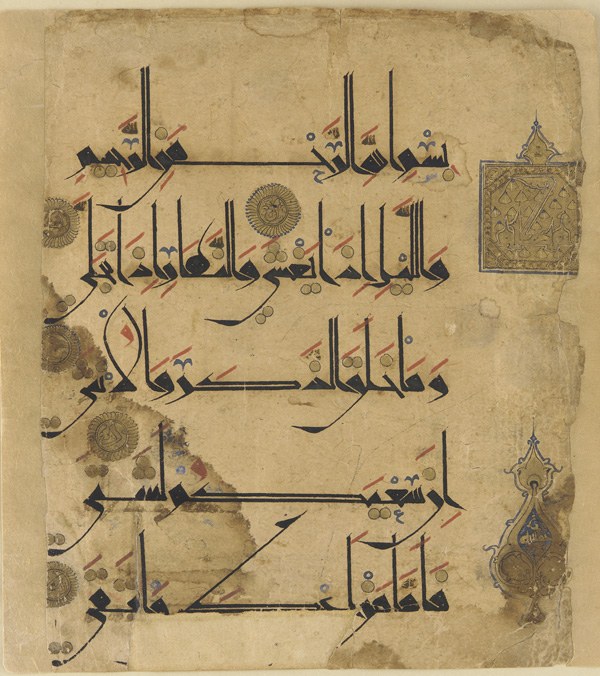
Islamic Golden Age art covers the visual culture produced under Abbasid rule and its regional successors from the dynasty's founding in 750 CE to the Mongol sack of Baghdad in 1258, across territory stretching from Spain to Central Asia. It was made for caliphs, regional courts, mosques, and a prosperous merchant class, in a religious context that generally avoided figural imagery in sacred settings, pushing artists toward geometry, vegetal ornament, and calligraphy as primary decorative languages instead. The Quran's status as revealed text in Arabic made calligraphy itself a major art form, copied and elaborated across mosque walls, manuscripts, and metalwork. Mosque architecture developed its own vocabulary of horseshoe and pointed arches, forests of columns, and, later, intricately carved muqarnas vaulting. Beyond religious settings, courts commissioned lusterware ceramics, inlaid metalwork, and illustrated secular manuscripts that did include figures, since the restriction on imagery applied most strictly to religious contexts. Trade and scholarship connected these regions into a shared, cosmopolitan visual culture, one that also absorbed and transmitted motifs from Byzantine, Persian, and Central Asian traditions.
The look: what defines Islamic Golden Age Art
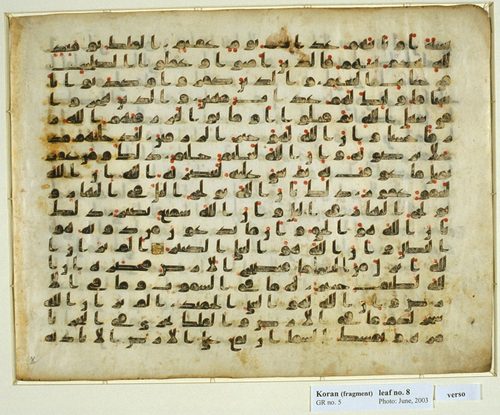
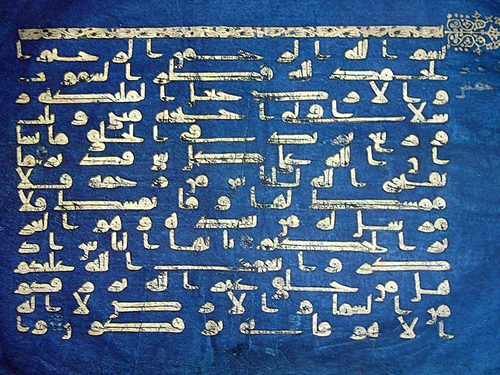
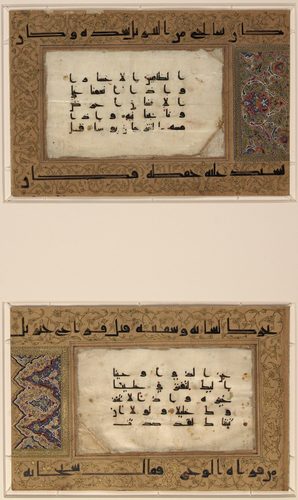
Calligraphy as sacred art
Because the Quran was revealed in Arabic, elegant script became a primary religious art form, from angular, monumental Kufic lettering to later flowing cursive styles, covering manuscripts, mosque walls, and coins alike.
Geometric interlace patterning
Complex star-and-polygon patterns, built from a compass and straightedge and capable of extending infinitely in any direction, covered tilework, woodwork, and metal, suggesting an underlying order beyond the merely visible.
Arabesque vegetal ornament
Stylized, endlessly repeating vine and leaf scrollwork, called arabesque, filled borders and surfaces with rhythmic, non-figural pattern, an alternative to representational decoration that was especially well suited to religious spaces.
Horseshoe and pointed arches
Mosque architecture favored horseshoe arches, sometimes striped in alternating stone and brick, carried on forests of slender columns, as seen most dramatically in the great hypostyle prayer hall at Córdoba.
Muqarnas stalactite vaulting
From roughly the eleventh century onward, architects developed muqarnas, tiers of small carved niches that step and cascade like stalactites, dissolving a dome or archway's structure into pure ornamental texture.
Non-figural religious restraint
Figural imagery was generally avoided in mosques and religious manuscripts, though it flourished in secular contexts like palace decoration, illustrated literature, and painted ceramics, where courts commissioned lively figural scenes.
The story
The Islamic Golden Age begins with a change of dynasty. The Abbasid Revolution of 750 CE overthrew the Umayyads and, within twelve years, moved the caliphate's center to a newly founded capital, Baghdad, which grew into one of the era's great centers of scholarship, translation, and craft production.
Displaced Umayyad rule survived in Spain, where the emirate, later caliphate, of Córdoba built the Great Mosque of Córdoba from 785 CE onward, its striped horseshoe arches becoming one of the period's most recognizable architectural images. Across the wider Abbasid world, calligraphy, geometric pattern, and arabesque ornament developed as the dominant decorative vocabulary, suited to a religious culture wary of figural imagery in sacred spaces.
Regional courts, from Samarra to Cairo to Córdoba, competed through architectural patronage and luxury craft: lusterware ceramics, inlaid brass, and illustrated manuscripts for secular use, where figural scenes were permitted and often lively. Trade and scholarly exchange along routes connecting Spain to Central Asia let motifs, techniques, and ideas circulate across an enormous, culturally diverse territory.
This flowering ended abruptly in 1258, when Mongol forces sacked Baghdad and destroyed much of its accumulated scholarship and craft production, killing the last Abbasid caliph in Baghdad and closing the period even as regional artistic traditions, in Spain, Egypt, and elsewhere, continued to develop on their own terms.
Timeline
- 750 CEAbbasid Revolution overthrows the Umayyad Caliphate
- 762 CEBaghdad founded as the new Abbasid capital
- 785 CEGreat Mosque of Córdoba begun under Abd al-Rahman I
- 836 CEc. Great Mosque of Kairouan rebuilt and expanded
- 848 CEMalwiya spiral minaret built at Samarra
- 965 CEc. Córdoba's mihrab mosaics added under al-Hakam II
- 1258Mongols sack Baghdad, ending Abbasid rule
Works to know
| Work | Maker | Date | Why it matters |
|---|---|---|---|
| Great Mosque of Córdoba | Unknown | 785 CE–10th century | A hypostyle prayer hall of red-and-white striped horseshoe arches, expanded over two centuries into one of the era's largest mosques. |
| Great Mosque of Samarra and Malwiya minaret | Unknown | 848–852 CE | An enormous Abbasid mosque with a distinctive spiral minaret, built during Samarra's brief tenure as caliphal capital. |
| Great Mosque of Kairouan | Unknown | c. 836 CE rebuild | One of North Africa's oldest and most influential mosques, its horseshoe-arched prayer hall a model for western Islamic architecture. |
| Blue Quran | Unknown | c. 9th–10th century CE | A Quran manuscript written in gold Kufic script on indigo-dyed parchment, among the most striking works of Islamic calligraphy. |
| Abbasid lusterware ceramics | Unknown | 9th century CE onward | Metallic-sheened glazed pottery pioneered in Abbasid Iraq, a technical innovation that spread across the Islamic world and beyond. |
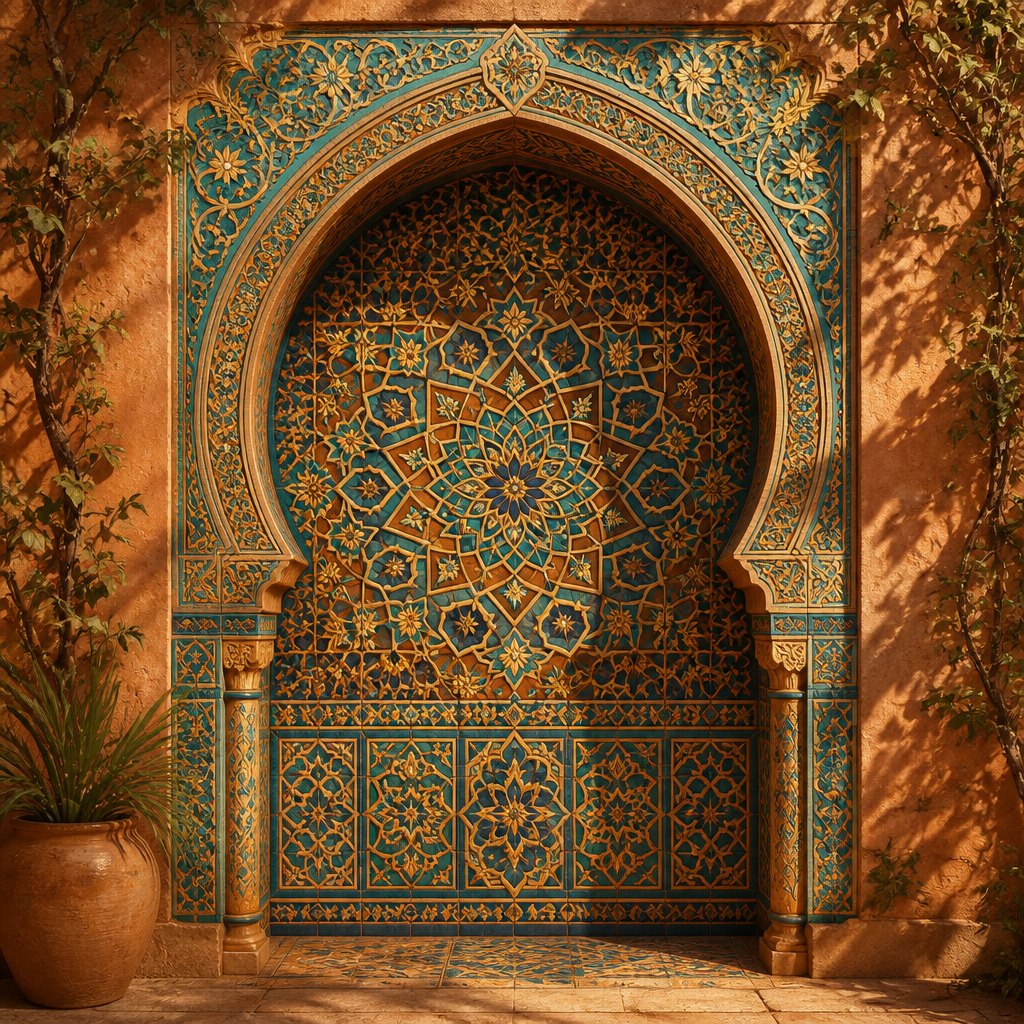 AI-generated
Make it yourself
Create art in the Islamic Golden Age Art spirit
This interpretation was generated from a prompt like: “An intricate tiled archway filled with interlocking star-and-polygon geometric patterns and flowing vine scrollwork, deep turquoise and gold against warm terracotta stone, horseshoe arch silhouette, soft raking desert light, richly detailed symmetrical surface.”
Open the Islamic Golden Age Art Style generator →How to evoke the period
Build surfaces from interlocking geometric star-and-polygon patterns or rhythmic, repeating vine scrollwork rather than a single figural subject. Favor deep blue, turquoise, and gold against warm terracotta or ivory ground, with fine linear detail throughout. For architecture, use horseshoe or pointed arches, striped stone-and-brick banding, and tiered, honeycomb-like vaulting that breaks a surface into cascading small niches. Keep patterns dense, symmetrical, and edge-to-edge, avoiding large empty space, and let ornament imply an order that could extend infinitely beyond the visible frame. Reserve any figures for a clearly secular, courtly scene.
What it left behind
Geometric pattern, arabesque ornament, and calligraphic design developed in this period remain foundational to Islamic art and architecture worldwide, still visible in mosque decoration, textiles, and contemporary design. Muqarnas vaulting and horseshoe-arch architecture influenced building traditions from North Africa to South Asia. Lusterware ceramic technique spread into medieval Europe through Spain and Italy, shaping later Mediterranean pottery. The era's scholarly translation and preservation of Greek, Persian, and Indian texts also fed indirectly back into European art and science once that knowledge reached the West. Córdoba's mosque remains one of the most visited monuments of the period.
Frequently asked questions
What is Islamic Golden Age art?
It is the art and architecture produced under Abbasid rule and related dynasties from 750 to 1258 CE, spanning the Middle East, North Africa, and Spain, known for calligraphy, geometric pattern, and arabesque ornament.
When was the Islamic Golden Age?
It ran from the Abbasid Revolution in 750 CE to the Mongol sack of Baghdad in 1258 CE, a period of major achievement in art, architecture, and scholarship.
Why does Islamic art avoid figures?
Religious art generally avoided figural imagery out of caution around idolatry, favoring calligraphy and geometric or vegetal pattern instead; secular art, like palace decoration, permitted figures more freely.
What is muqarnas?
Muqarnas is a form of architectural ornament using tiers of small carved niches that step and cascade like stalactites, used to decorate domes, arches, and vaults.